Paris and Beyond

Our Personal Tour de France & Other Exciting Adventures!

Culture ~ Pride or Prejudice

Finally, the next in Norman’s series of articles on culture.
imageThere are several definitions of pride, ranging from having a high level of self-esteem to possessing or holding a righteous view of oneself to the exclusion of almost all others. Interestingly, prejudice is defined as a feeling of like or dislike for someone or something especially when it is not reasonable or logical. So, does being prideful or prejudicial necessarily mean that someone is a bad person, ignorant, or someone that should be condemned for his or her likes or dislikes? Not necessarily, after all, in this day and age of “political correctness” that is, chastising anyone for being judgmental, doesn’t everyone have a certain amount of pride or prejudice for or against one thing or another? Because of the many terrible events that have occurred in regards to race relations both in the U.S and other countries around the world that have garnered lots of media attention recently, “prejudice” has acquired the negative aspect of the definition. Unfortunately when any word is constantly associated negatively, the negative association can dominate.

Consider this. Language is neutral, without bias or agenda of its own. It is the way people chose to use language that gives words their meaning and connotation. For example, I have a love of Jazz music. An even stronger one for Latin Jazz. In other words, I have a prejudicial preference for jazz just as I have bias against the use of foul and offensive language or behavior in public.

One of the benefits about traveling or living in other countries is that you get to learn so much about other cultures. What is surprising, however, is how that experience can change you. As I’ve mentioned in a previous blog, if you are exposed to a different culture other than your own, at some point you will to begin to see your own culture through different eyes.

Does this mean that you have to accept and adapt to every aspect of another culture? I can’t remember meeting anyone who was so accepting and unbiased that no matter how someone expressed themselves culturally, that person accepted them entirely and wholeheartedly without reservation of any sort. We’re all products of our upbringing and our cultural views. And, there are instances where we must use our judgement (sometimes referred to as our gut feeling) to keep us safe. There are also times when experiencing another culture causes strong emotional reactions for or against what one has experienced. A quick example is when I was living and studying abroad. I recall that on the subway train, I found it very rude that people would stare at me for long periods of time. Being in a country where I was a rarity made people very curious and one way they expressed this was to stare. But I mean staring in a way that in the U.S. is considered very rude if not threatening. There are other examples that I could give that are much cruder, but the purpose here is not to incite but to elucidate.

As in any culture, there will be things that one will embrace and others that one will reject. People are not perfect and will create stories to either explain away something of another culture’s habits or practices or to show a difference between their own. In a way, one could equate this to myths. Not the myths of fables, story tellings, folklore or saga but the “false beliefs” that most cultures create in order to explain away things they don’t understand of another culture’s expressions. So where am I going with all of this? Well, for me, in order to be able to travel abroad and do so in a way that allows me to have positive memorable experiences, I must free myself of the debilitating negative prejudicial stereotypes that I bring from my own culture. Once you can get to that point you will find that those negative views previously held by you, free you of the stress, doubt, fear and reactionist behavior that can make traveling a horrible experience that you never want to repeat again.

Educating oneself of another people’s culture is the surest way of beginning to understand and appreciate them. Although I was brought up in a small, impoverished neighborhood, I did have exposure to a few other cultures but what really opened my eyes and mind was when I was exposed to so many people from around the world during my undergraduate college days. One of my most memorable learning experiences (and rather humorous but embarrassing story) was when I was attending a student-run international dinner on campus.

As part of the evening’s dinner entertainment, an international exchange student from Brazil played and sang to what then was still immensely popular Brazilian Bossa Nova music on his acoustic guitar. His playing and singing was very exciting for me as I was familiar with that genre of music, having listened to recordings by Charley Bird and Stan Getz, Cal Tjader, Sergio Mendez and Brazil ’66 and other great jazz musicians as well as original versions by the creators of the genre, Tom Jobim and Astrud Gilberto. I loved it! After the exchange student’s wonderful performance, I got the chance to ask him the following question: “I was listening to you singing and was wondering; is Brazilian a mixture of Spanish and French? I can understand some Spanish words in your language but I can’t understand any of the rest”. Well, as you can immediately tell, I had no clue that Brazilian was not a language but a people from the country of Brazil. Their language, Portuguese was what I was completely ignorant of. The young man was very gracious and patiently and gently educated me on the subject. While I felt completely humiliated and embarrassed for my own ignorance, I at least walked away enlightened with the thought that not too many of my fellow students had noticed my faux pas. One thing I now know is not to make assumptions when it comes to other languages. Although I have been studying French for some time now, I am learning how words that are similar in Spanish take on an entirely different meaning and usage in French. So I now approach my studies of the French language with an open mind and without making too many assumptions of what a word or phrase means, or how it it used.

On my first trip to France (a long time ago), I recall walking down a charming narrow street in one of the older sections of Avignon. As I was passing a small Bistro, an attractive young girl was standing on the side walk in front of the Bistro inviting passersby to stop in and give it a try. As I approached her, she greeted me in a beautiful sing-song lilting French, inviting me to go in. Although I did understand her, but having studied very little French at the time, I simply told her that I was sorry but that I didn’t speak French. To my surprise she replied “mais, pourquoi pas?vous êtes en France.” (but why don’t you speak French? You ARE in France.) All I could do was to say “yes, it’s true, it’s true. This little encounter made me realize that while it certainly is impractical to learn every language of every country that one would like to visit, at least learning a few courteous words and phrases goes a long way to making one’s travel much more pleasant. Traveling in a country that doesn’t speak your language can be challenging.

A more recent encounter was when Cheryl and I went to a small but famous French restaurant in Lyon to enjoy our first quenelles, invented by the chef/owner of the restaurant. Having dressed appropriately to enjoy an evening meal and at least trying to order our meal in French, the waiter instantly realized we were not French and also didn’t speak much French, nevertheless he treated us respectfully and provided excellent service. On the other hand, a fellow American who was dress rather causally, walked in sometime after we were seated and tried to have a long, friendly personal chat with the bartender and another waiter telling them both that he was an American from Texas. Speaking loudly, he went on telling them about his life, travels in France, and other more personal details about himself and his wife. Both the bartender and the waiter glanced at each other with the slightest rising of their brows and rolling eyes. Needless to say, there wasn’t any seating available and they let him know it albeit with as much courtesy as they could muster. In France, the French never speak so casually to anyone they do not personally know. And so, to the bartender and the waiter, the Texan came off rather rude, pretentious, and uncultured.

A little preparation goes a long way. Traveling is stressful. Planning, packing, financing, budgeting, timing, making connections, and all of the myriad details that need to be attended to as well as the unexpected and the “accidental” things that can and do go wrong, must be dealt with, willingly or not. By educating yourself about all the important aspects of your trip beforehand, you can eliminate most of the uncertainty and stress thereby gaining confidence and strength to overcome your fears and doubts. This same practice works when you educate yourself about another culture. Even a small effort can pay large dividends.

In my next post, I’ll recount a story whose humble beginnings lead to a long and fruitful relationship.
Getting into the Pool

imageAs I think about our French studies over the past year and look ahead to our 8-week adventure in France which begins tomorrow, it occurs to me that the way in which my husband and I approach learning the language is very much akin to how we go about getting into a swimming pool. Norman is inclined to just jump in all at once and swim. This is how he speaks French. He’s not afraid to just go for it. It’s exactly the philosophy I use when I’m teaching Spanish to my students so they won’t struggle like I did. I want them to try to speak Spanish all the time even if it’s only in bits and pieces with a few English words thrown in. I want them to avoid the incredibly long period I spent learning to speak Spanish as opposed to memorizing vocabulary, understanding the grammar, and learning how to read and write it which I favored and was really good at accomplishing. However, this is contrary to the way one learns his/her native tongue. Babies immediately begin to mimic what they hear and with repetition, quickly become successful enough to express their desires and build relationships through simple but intelligible communication. This manner of acquiring language is totally natural and logical and should be the method employed in any language class. It’s the concept behind immersion programs where native speakers from two languages are mixed together in the same classroom so they can learn from each other. Of course, this works especially well at a young age when children have no inhibitions — often a problem for teens and adults.

When I get into the pool, I prefer to take it one step at a time, literally… wading into the shallow end slowly step by step, getting used to the water temperature little by little, descending the last step to stand on the bottom of the pool, getting wet up to my waist, walking across to the other side where I plan to start my laps, sinking up to my shoulders, swimming the first lap with my face out of the water, then, finally, getting completely wet and down to the business of swimming my 20 laps. Even though I’m an excellent swimmer, have taught swimming, and lifeguarded, I still need to become acclimated to the water temperature every time. Once I get used to it, I always wish I had just jumped in from the beginning because it takes so much time to finally get busy swimming those laps and there’s actually much less suffering involved. Unfortunately, this process is identical to my efforts at relearning French. I’m not very good at practicing what I preach. So I am hoping that, at some point in the next 8 weeks, I can get past that initial hesitation and just try to speak French no matter how limited I am or what I sound like. For a life-long introvert like me, this is a big challenge but one I am motivated to take on in order to achieve what I want in the next phase of my life. En français, s’il vous plaît!

Last Minute Details

imageTraveling away from home for 8 weeks is no easy task. While it may sound utterly appealing on the surface, it requires a lot of work to prepare for such an ultimately exciting adventure in order to guarantee that all will go well at your destination as well as on the homefront.

Destination – France: After many, many hours of research last summer, all lodging was booked by September. There were several advantages to doing this so early. We have very specific requirements for the appropriate accommodations and a budget of no more than $100 a night. Since we always pay weekly rates for gîtes, apartments, and vacation homes, staying within that budget is fairly easy to achieve. Fortunately, these days most places are non-smoking, but we also prefer “no pets” plus we need wifi, an ample kitchen, and parking. Unless you are out in the country, parking is not easy to come by. All those factors eliminate a lot of choices. The prime accommodations usually fill up way in advance because they get a lot of repeat customers who book a year ahead. Booking so early afforded us more options to consider and saved us money as we were allowed to pay last summer’s prices in most cases. By February, we had arranged for our car and purchased our plane tickets. In April, we booked a shuttle to SFO and paid the balances on our lodging. So on Friday, we are taking off free and clear with the peace of mind that everything is taken care of and paid for which, in our opinion, is the only way to travel.

On the Homefront… With a year to make and refine lists including everything that goes in our suitcases and carry-ons, there is little chance we will forget something important. I oversee that portion of our travel preparations. Now is when Norman steps in and does his magic. As wonderful as any adventure may be, we love to come home to a house that is ready to live in once again. That involves a lot of cleaning, securing, and finding coverage for everyday tasks that can’t be put on hold. I am happy to say that I get to trade all that planning and packing for the cleaning and securing which is great because by this time of the school year I am quite exhausted. At work, I found a student willing to be a plant sitter for the pothos plants in my classroom and a gracious colleague willing to pick up the mail once a week. The rest is up to Norman. His duties include “torturing” the Japanese Maple so it will grow into the right shape during the summer, planting a tomato plant that will bear fruit in August, and fertilizing all the plants on our patio. Someone has to check in on all those plants from time to time and make sure the watering system is working and Norman has made sure that is covered too. There are some odd jobs you might not think about — changing out all the old sink and toilet water lines so there’s no chance they will break while we are gone resulting in flooding, anchoring large ceramic vases and the TV in case we have one of those California shakers, and pulling out the stove to clean behind it and reset the gas line so that instead of sticking out two inches, the stove will set back in closer to the wall. What?! Why that last task — just something Norman has had on his to-do list for years. The usual things that need attending before any trip will happen just before we go — storing valuables, setting up lights on a timer, and locking down all doors and windows. You may think all these preparations are crazy, but we so appreciate the absence of chaos while we are gone and when we return.

On the countdown… 5 days and counting – What could be left to do? Get haircuts, color my hair, do my nails, renew my license at the DMV (in person required this year), postpone jury duty (scheduled during our vacation), visit dentist for cleaning, change the sheets, clean out the fridge, and call bank and credit card companies to inform them of our travel plans (otherwise, your first charge at that magnificent three-star Michelin restaurant might be denied). Oh, and teach a couple more days. Whew!! I think we are ready.

P.S. Best list app ever — Dropkick which syncs on all devices. Love those checkboxes!!

The Little Red Suitcase

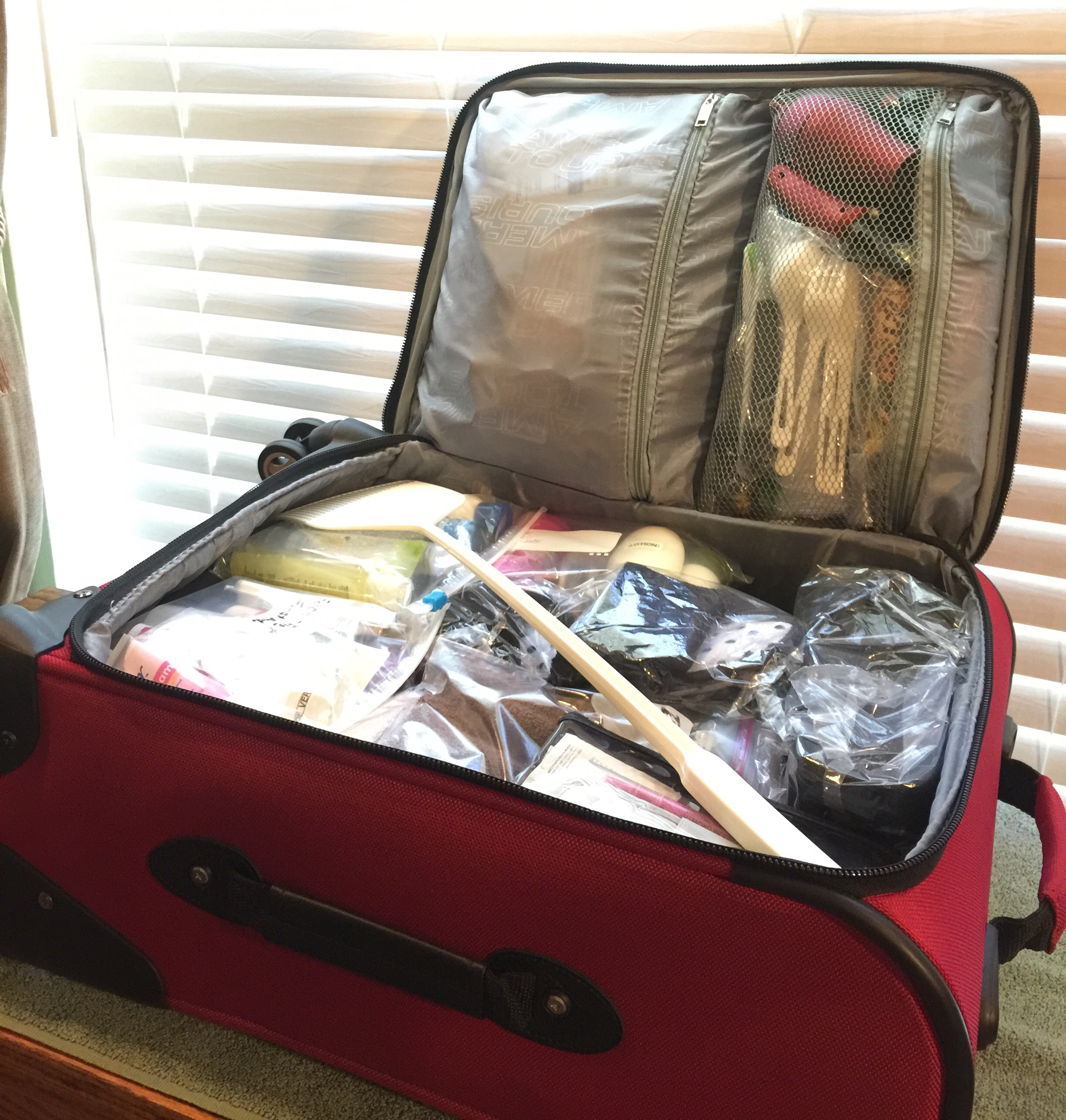
imageBefore I even thought about packing clothes in my carry-on, I had to figure out just exactly which miscellaneous items were going to go into the extra carry-on we would check. Spending the summer in France is not equivalent to spending the summer in San Antonio, Chicago, or Miami. You’re not going to find all the big box stores and familiar-looking strip malls to which you are accustomed in your own hometown. Though we recently learned that the first Costco will open later this year just outside of Paris. When I travel within the U.S., my philosophy is always that if I forget to pack something, I can buy it when I get there. Such in not necessarily the case in France as our previous trip revealed. In addition to the fact that you have to conduct transactions mostly in French, it can be quite a task to find that needed item in a store or even to figure out which kind of store will carry it.

So, based on our last experience, here’s what we’re taking in that extra bag…

  • Picnic Supplies – Even though the French are apparently really into “le picnic”, we found it very difficult to locate any of the requisite items for a picnic basket. We managed to find one Cost Plus-type store in Paris and made do with the things we found, but there was very little inventory. So we have packed a collapsible cooler plus a couple of freezer blocks, plastic flatware (from one of our favorite boulangeries), plastic wine cups (the nice ones for the patio that are intended to be reused), plastic plates (reusable but eventually disposible), cocktail napkins (umm… yeah, I know these are not really required, but in my case they are as I just can’t get the right ambience going without them — at least I’m not taking a variety of confetti that is usually part of my tablescapes — well, actually I did make one exception, but we’ll get to that much later), a wine corker (but, of course!), a wine bottle stopper (I don’t know why because we usually drink the entire bottle), and a tablecloth (the same one you may have noticed in photos from our 2012 trip). Seriously, you have to have a proper picnic and I expect we’ll be having a lot of them.
  • Fly Swatter – Yes, really! When we got to our first gîte in Provence, we realized that the French do not believe in putting screens on their windows, but they most certainly have a lot of flies. Our search for what we now know is called a “tapette à mouche” at the local Super U was finally successful once Norman found a roundabout way of describing what we wanted in French. This time we are taking no chances. As an accompaniment to the fly swatter for those picnics and outdoor meals, we are also taking a food tent.
  • Waterproof iPhone Cases – I will not have to worry about getting dumped into the Dordogne again with my iPhone tucked into the top of my bathing suit or Norman’s in his bathing suit pocket. We loved our canoeing adventures last time and plan to repeat them any chance that we get. It’s an absolutely prime photo opp and you can’t keep digging your phone out of that watertight barrel they give you when you rent your canoe.
  • Tea Bags – both regular and iced – The French primarily drink coffee which I can no longer drink. There are plenty of Brits, especially in Southwestern France where we will be traveling, who drink tea, but they prefer blends such as Earl Grey or English Breakfast. Suffice it to say that there’s not the wide selection of herbal teas that we have at home which are required if you have to cut caffeine out of your diet. And, those large Tazo iced tea bags seem to be an American invention.
  • Hand Fans – It eventually gets hot in the summer and unlike here in the U.S., you will hardly find air conditioning anywhere. You can buy fans in pretty much any open-air market, but they cost something like 8 euros and are imported from China. We really wanted a couple but decided we could live without them at that price. Our friendly Daiso $1.50 store supplied us with two that will do the trick.
  • Washcloths – The French don’t use a washcloth as we know it. Instead, they use a “gant” or terrycloth mitt. Even these were hard to come by in the places we stayed or stores we perused. I guess we will have to get used to them when we move to France, but, for the time being, we’re settling on taking a couple of our own from home.
  • Power Adapters – Since our phones and iPads will be traveling with us, these are imperative. After a long plane trip, they will all surely be dead by the time we reach French soil so it’s not practical to wait until you can pick some up at the local “quincaillerie” (hardware store) or electronics store. Fortunately, we don’t need to pack those cumbersome converters as all our devices are designed to work on 110 and 220 volts. We’re also taking a simple car charger which will plug in to the 12-volt port or cigarette lighter of our Peugeot which, thankfully, is identical to those in American vehicles.
  • Plus… Umbrella (to guarantee it won’t rain), Ziploc bags of various sizes (another American fetish), real Maps (so we won’t end up not being able to figure out how to get “home” when the GPS on our car decides to quit — we almost had to camp out in St. Emilion), Aprons (for all that cooking we’ll be doing and washing we don’t want to have to do in sometimes complicated French washing machines), Shoes, Toiletries, and various sundry items.

As you might guess, several of these things won’t need to make the trip home and our luggage will be a bit lighter or so Norman hopes. We don’t generally bring back any souvenirs beyond our photographs so unless we hit up the “Soldes” (sales) somewhere in July, I think there’s a good chance of that happening. By the way, contrary to the almost weekly sales we experience in this country, in France they only occur twice a year in July and December.

You would never imagine taking along such a menagerie of things, but it’s a matter of making sure you are comfortable while figuring out and learning how to adjust to the French way of living.

All Packed!

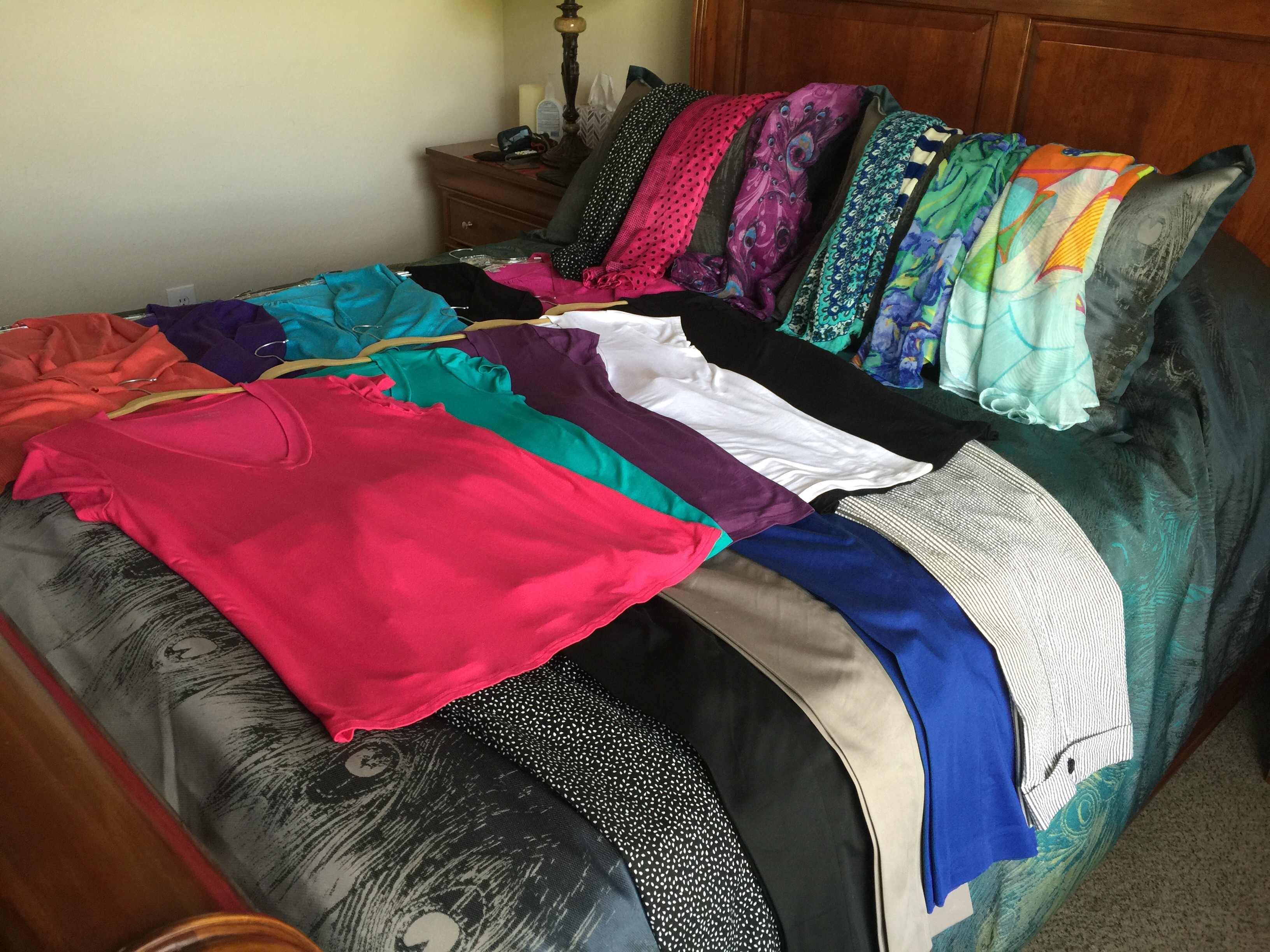
imagePacking for a trip can be fun and frustrating at the same time especially for women. It’s exciting to think about what you will do when you arrive at your destination while you are filling that suitcase with your favorite clothes, but it can be challenging to figure out exactly what you will need for all your activities and how it will all fit in your carry-on. For someone like me who loves clothes AND shoes AND scarves AND jewelry AND all the other accessories, it is particularly difficult. I love the idea of a simple capsule wardrobe for travel which essentially is a set of clothing with a limited number of items that can be mixed and matched to create a wide variety of outfits. It makes total practical sense. I have read blog after blog on this topic, but I never seem to be quite sold. Plus, travel capsules are usually geared to vacations of no more than one to two weeks. We’re going to be in France for almost 8 weeks ending with one of those (ahem!) big birthday celebrations for which I certainly have to have something special to wear. So I’ve decided on an extended capsule wardrobe.

A trip to France during the summer starts out cool and perhaps wet and ends up being rather, sometimes uncomfortably, warm so it’s definitely important to layer. For me that means a couple of pairs of pants and about five pairs of crop pants all in neutral colors. Added to that will be 6-7 knit tops in solid, brighter colors plus a variety of three-quarter sleeved sweaters and last, but certainly not least, since I am going to be in France — a selection of scarves. Yes!! All items will be rolled to avoid wrinkles and most packed tightly into ziploc bags which when compressed and zipped will conserve space. In order to picture the combinations of my choices, I layed all of the potential main pieces out on the bed a few weeks ago and then photographed them so I would remember what I had settled on. I think this will work out very well and just to make sure, I will be packing two weeks in advance. That way I have time to add or delete items and take care of any last minute inspirations.

But what about all that “other” stuff? On our last trip, we each took one carry-on suitcase and checked a very large suitcase with all of our miscellaneous items. That large suitcase proved to be quite a nuisance. It was a pain to lug around and some of our accommodations were so small that it was nearly impossible to open or store it. We vowed not to make that mistake again. So this time we will pack all of our clothes and a few accessories and toiletries in our individual carry-ons and check one more carry-on size suitcase which happens to be bright red and hopefully, easy to spot in the baggage claim area. And what’s going into that red carry-on? Well, you’ll just have to stay tuned for the next post. It’s rather interesting.

Back to our Future

imageOnly 18 days and counting! It’s almost time for our return trip to La Belle France. This will be our opportunity to decide if retiring there in two years is really the right move. We are traveling more as researchers than tourists and though we will certainly enjoy the sights, our minds will be more focused on discerning what life might be like living in France every day.   

Our last trip in 2012 gave us a broad perspective of the country and its diversity. Based on that experience and much research into various regions, we have narrowed our search to southwestern France which among other things in its favor boasts a climate similar to that of the Bay Area. We are flying to Bordeaux by way of Amsterdam where we will pick up a brand-new Peugeot that will be ours for the duration of our eight week stay. It is imperative to have a car in order to explore beyond the limits of tourism and public transportation. We will travel to eight different locations in the Poitou-Charante and Aquitaine regions staying in most for a week at a time. Our accommodations range from townhouses to gîtes and country homes that are generally larger and roomier (by French standards) than those on our previous vacation. Some are located in cities or towns while others are in the suburbs or completely out in the country. Our goal is to try on a variety of living situations and see how they fit. Granted each one will only be for a short period of time, but at least we will have some real life experience that will contribute to making decisions and plans for our future.

As for speaking French, we have made a concerted effort to study and improve our skills over the past year and are much better prepared to make our best effort to communicate in French. In addition to the fact that he has more time than I do to study, Norman’s musicial ear makes it much easier for him to differentiate the sounds between Spanish and French — a task that’s made more difficult for me due to the fact that I teach Spanish all day long every day. Since they are both Romance langauges (as in derived from Latin spoken by the Romans — not necessarily romantic), it does give us some advantage to be fluent in Spanish. As ever, I remain the grammarian and Norman takes on the role of communicator. Nevertheless, I am determined to get out there and delve into some, albeit simple, French conversation. Immersion is the key. There’s only so much you can learn in a void.

We’d like to invite you to join us on this adventure back to France — potentially our future home. Meanwhile, if you are new to following this blog, please take a look at our previous posts via the Archives on this page where you can get caught up with our past adventures and find more information about how we’ve arrived at this juncture in our lives.

Culture ~ An Identity

While Cheryl is the main moderator of this blog, her husband makes contributions from time to time especially when they are traveling and post daily. Currently, from their home-base in California, he hopes to produce one of the following such articles every few weeks or so sharing his unique perspective.

In Norman’s Words…nlp_beret
The main focus will deal with culture as it relates to me and how I have been shaped by it. This series of articles will be based on opinion. My opinion. I am not an expert on the subject and so these articles will not be based on studies, surveys, data, writings sources, or conclusive or exhaustive examinations of the subject. My opinion is solely based on over six decades of observation and living through some of history’s most memorable events and some of mankind’s highest (and lowest) achievements. My opinion is shaped by my exposure (as an American) to local, national, and international events as well as to my efforts to try to educate myself and go further in seeking unbiased, accurate information wherever I could encounter it.

I feel very fortunate to have been born at the time that I was because (so far) my existence has encompassed a vast and fascinating period of history that has seen events and conditions that may never (and some, hopefully, will never) occur again. I realize that everyone can look back at their lives and say, “I remember when…”. But I feel that people of my generation and older have had a unique experience. An experience that has allowed them to straddle a rich period of history full of such important and unique events that few other generations can fully appreciate.

I hope you enjoy what I have to say. You may or may not agree with my opinion as we all see the world with our own eyes and arrive at conclusions by our own life’s experiences.

Who Are You?

Everyone that is old enough and has had enough life experience can tell you of the times in their lives when they became aware of certain events that changed them in some way or another. I can certainly remember events that changed me. For me, these events made me aware of or reflect on past ideas or behaviors and allowed me to embrace new ones, new ones that hopefully changed me for the better.

Having been brought up in a large family with parents that had very little opportunity for an education and a father who could only find work as a field hand, didn’t make for a life of luxury nor opportunity. No travel, nor exposure to other cultures, their language or traditions. Living through an era when being of a different culture and speaking a different language made many children feel self-conscious and belittled, was a very difficult experience. Brought up in a household where speaking Spanish was the primary language, while attending grammar school as a young child, I remember the white teachers all throughout elementary school changing my friends’ Spanish given names to anglicized versions that they found more palatable. For example, my neighbor and friend Carlos’s name was changed to Carl, Jesus was changed to Jesse, Margarita to Margret, Juan to Johnny, Guillermo to Robert, Jaramillo to Jerry and so forth. I also became aware of the attack on the language itself because at school, we were forbidden to speak it. I’m not sure at what young age I became aware that if I wanted to become accepted by a wider scope of people (by this I mean generally – white people) I had to learn and become fluent in English. As it turned out, by the time I was in high school, I was fluent in English alright. I made such a concerted effort to become fluent in English that I almost lost my ability to communicate in Spanish entirely. While I could understand my father (who spoke to me in Spanish), I could not respond to him in kind. I could only do so in English. In fact, I became so concerned about this problem that I decided that I needed to relearn my Spanish and so, took Spanish language classes.

Having studied Spanish, I gained an insight I hadn’t had before. That is, how expressive and beautiful the Spanish language is. My reawakening has given me a new appreciation for stories, songs, music, cultural expressions, and the power and beauty of poetry.

Another experience I had that changed the direction of my life was when I was exposed to people from other countries. As an undergraduate student, I joined an on-campus club of international exchange students where I learned about the vast differences (as well as similarities) of people from around the world. By the time I was in graduate school, I participated in an international student exchange program that allowed me to live and study abroad in a non-English speaking country. Although I learned many things about that culture, the real learning experience was about myself and my own culture. For me, there is no better way to learn about yourself and your culture than living in another one and looking back at your own through their eyes. You take on a perspective that you didn’t realize existed.

Culture to some people means anyone that speaks a language or eats foods different from you. But culture is far more than that. If you think about it, what makes up culture is not only the language and food, but the vast expression of a given group of people that encompasses their beliefs, values, arts, religions, political and social systems, legends, folktales, and stories. In short, it is their cumulative knowledge gathered over time and passed from one generation to another.

So, what makes up your culture? What are the most obvious things that stand out about it? And what makes you a part of it?

In the next part, “Pride or Prejudice” I’ll explore what I believe opens one up to accepting and appreciating new cultures and also, the fears and uncertainties that can keep one from doing so.

Falling in Love

One of the things I have been doing in preparation for moving to France is reading all manner of books about France — informational books on regions, retirement, rules, and regulations as well as books people have written about their own experiences moving their lives to France. Recently, I finished reading Living in France Made Simple by Tanja Bulatovic, a Serbian who lived in many different countries until she finally landed in Australia. At 40, she found herself in very unhappy circumstances which included a divorce. Shortly after, she a met and fell in love with a Frenchman and followed him to France where they eventually married and took up a rather adventurous life. While I am not quite the gypsy and wanderer Tanja is, I can very much relate to her story, her feelings, and her attitude about life. She believes that instead of always making safe choices, we should opt for rich life experiences. In other words, we shouldn’t be afraid to follow our dreams.

LoveMy life definitely took a turn in a different direction when I was 40. I am so thankful I had the courage to pursue new opportunities. Everyone deserves to be truly happy in life, but sometimes you have to be willing to make difficult changes to get to that place. I am very fortunate to have found a partner who values the same things I do. We both like to learn and experience new things. Many people are satisfied to remain in familiar surroundings and follow a set routine in retirement. It feels safe and they know what to expect every day. When I retire, we will have spent 12 years in the same area and while it’s an amazing location, we have pretty much explored everything and exhausted all the wonderful adventures near and far. We thrive on the constant challenge of adapting to new situations and the broadening of our perspective on people, cultures, and the world that comes with them. Moving to France will be our next challenge. Embracing the idea as we are right now with our research and French studies will bring it closer to our hearts.

At the end of her story, Tanja suggests that you should “allow yourself to fall in love a little. Be seduced.” When people ask us why we have chosen to retire in France, it’s always difficult to answer that question because there are so many complex reasons. I suppose the best answer is that we have fallen in love with France and been seduced. So now we have to see where this relationship is going. It takes a lot of patience, understanding, and compromise to make a relationship work. We have constantly practiced this with each other. Hopefully, our love affair with France will be as long-lasting and as happy as our own.

Bon Courage!

keep-calm-and-bon-courageI ran across this expression in a book I read recently. The context in which it was used easily conveyed the depth of its meaning, but I also did some research. Many times there aren’t truly accurate translations for certain words or sayings in another language. They’re culturally based and lack concrete explanations. This is one of those cases. However, my understanding is this — Bon Courage is used to wish someone well who endeavors to accomplish a challenging task where success is dependent upon personal strength or resolve. On the other hand, Bonne Chance, which translates more closely as good luck, is used to wish someone well in a situation where a person may succeed or fail due to purely external factors. In English, we don’t really distinguish between these circumstances and tend to wish people good luck for everything regardless of internal or external factors. I was charmed by the idea that the French have diversified this concept.

As my husband and I attempt to recover and relearn what French we can before moving to France, I realize that we have two options. We can take on the attitude of Bonne Chance or Bon Courage, sometimes shortened to the simple exclamation Courage! After all, there’s more to learning a language than just vocabulary, grammar, pronunciation, and spelling. One must learn to understand and adapt to cultural mores as well. It seems like this business of luck would be a good place to start. We can choose to follow the path of Bonne Chance or Bon Courage and I, for one, prefer the latter. I think it truly requires a lot of willpower and determination to learn another language and assimilate to another culture at this point in ones’ life. However, I believe that if we make a concerted effort, we can transport our lives to France and transform ourselves into comfortable expats. The mental approach of courage, which correlates to our use of the word “courage”, makes the whole process sound so much more achievable.

Even before stepping one foot on French soil, I feel I have at least cracked open the door to a tiny bit of French culture. At the same time I am trying to speak like the French, I need to learn to think like the French.

What do you wish to achieve? Whatever it is, don’t wait for fate to get you there. Bon courage à tous!

La Rentrée

I have been in school either as a student or a teacher since I was five and, if you figure out my age, you’ll realize that’s a ridiculously long time. Like I tell everyone, I must really like school or I wouldn’t still be there. Contrary to most people, the “years” in my life begin in August and end in June. The January to December calendar idea doesn’t really exist in my mind. So I love the fact that the French have a special name for our traditional and highly marketed Back-to-School time of the year. For the French this also refers to going back to work as many French citizens go on holiday for most, if not all, of the month of August. La Rentrée, as they call it, applies to the whole country in September not just teachers and students. I think this is pretty cool and truly quite chic. Apparently, the expression “À la Rentrée” is exchanged in the same manner one might say, “Have a nice vacation”. It serves to convey good wishes to a friend as he/she returns to school or work. While I have never experienced this myself, I imagine this to be a much more universally positive concept than it is in the U.S. where children dread it and parents breathe a sigh of relief.

school-lunch_menu-1-01When French children return to school, they have many new things to look forward to — teachers, books, lessons, and something that disappeared from our schools many years ago — lunch menus that include varied and appetizing foods planned months in advance by the school cafeteria staff and approved by a dietician. Wow! I bet most of the people reading this blog are not old enough to even remember a vestige of this when they were in school. At least in my state of California, cafeterias have become nonexistent along with the people who used to prepare fresh food and serve it on trays. These days, my students hang out around the open-air spaces outside our classrooms, often sitting on the cement or AstroTurf while hurriedly munching on junk food from home or an odd variety of items contained in a small plastic-covered box they have paid for from a catering service while glued to YouTube videos on their iPads very little personal interaction. Yes, I teach at a rather privileged school to say the least, but I have also worked on the “other side” and it didn’t look much different. It’s no wonder celebrity chef, Jamie Oliver, started a campaign to revamp American school lunches known as his Food Revolution. If you’d like a taste (pardon the pun) of French school lunches, check out this article written by Rebeca Plantier, CEO and co-founder of Fit to Inspire. As you will see, it’s not just about the freshness and variety of the food, but also the atmosphere in which students partake of their meals as well as the exercise they regularly get. Like the Rebeca says, it puts us to shame. We should take a lesson!

So it is that I must blame my own “Rentrée” for such a long time between posts. Not only has my blog suffered from neglect but so have my French studies. However, now that things have settled into a fairly good routine, I am ready to get back to school myself. I just wish I could enjoy some of those French school lunches in the process.

Post Navigation