Paris and Beyond

Our Personal Tour de France & Other Exciting Adventures!

The Three C’s of the Perigord

More on our exploration of the Dordogne…
20120723-233912.jpg

CASTLES & CHATEAUS:
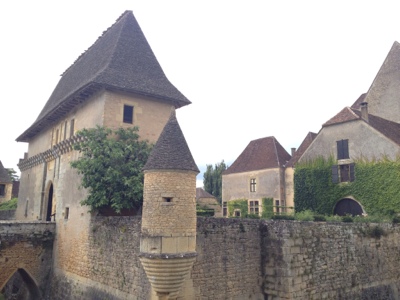
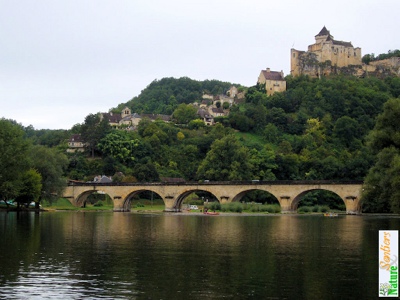
As I mentioned previously, there are countless castles and chateaus in this part of France — reputedly 1001. Though that sounds like a convenient number, I imagine it’s not far from the truth. We decided we needed to check out at least one of these grandiose residences that was near our gîte. The Chateau de Losse is a medieval fortress that sits on the Vézère River, the same one we made our canoe trip on earlier in the week. Originally built as a stronghold by the Losse family from Flanders in the 11th century, it was updated to the Renaissance style in the 16th century by Jean II de Losse, a well-connected soldier who served all the sons of Catherine de Medici. His improvements to the family home can be seen in the architectural additions as well as adaptations for the use of firearms such as muskets and cannons to defend it from invaders. As you might expect, you enter the castle over a bridge and through a gatehouse across a moat which is now filled with grass instead of water making it possible to view the castle’s exterior details from various angles. Once inside, you’re standing on a sprawling riverside terrace overlooking the Vézère Valley. Ascending a grand stone staircase, you are given a tour of a few of the main rooms which have been completely decorated with period furnishings, tapestries, and paintings to show how they may have looked over 400 years ago. Our guide did an excellent job of bringing the more interesting details to light even though her explanations were in French. One item was particularly clever — a large imposing powder and armor chest with a very ingenious locking system built into the underside of the lid. There is a very large iron key chained to the wall behind it, but the length of the chain does not allow it to reach the lock. That’s because there is actually an invisible, secret button on the lid that reveals the real lock to where the key can easily reach. Once open, there is an ornate, decorative cover that fits over the complicated locking system under the lid making it impossible for any observer to discern how it is designed. Wouldn’t it be fantastic to have a clever safe like this at home? Surrounding the castle are a variety of immaculately groomed gardens which include grapevines, lavender, wisteria, and many other types of plants and flowers in purposefully orchestrated arrangements as well as several fountains. Additionally there are a couple of outbuildings that you can visit. My favorite was the the bath room (literally — no toilet) with its “modern” bathtub consisting of a large, round wooden tub with a small stool inside and encircled by a curtain that hung from the ceiling. Apparently, cleanliness had (finally!) become popular and you were really up with the times if you had one of these.
20120723-234051.jpg

CAVES:
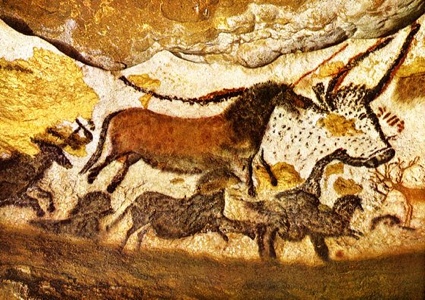
There are literally hundreds of caves in the Dordogne region. Known as grottes in French, they fall into two categories — those with cave paintings and those with geological formations. The most famous of these, of course, is the Lascaux cave just outside Montignac which was accidentally discovered in 1940 by 4 young boys while chasing after their dog, Robot. They planned to keep the discovery a secret but after just a couple of days, the whole town knew about it. They summoned their teacher who went down into the cave with them to investigate further. Astounded by the numerous colorful, artistic paintings of bison, horses, deer and other animals, the teacher decided the next step was to contact the local priest who had an interest in and knowledge of archaeology. The priest confirmed that the paintings were indeed ancient and brought it to the attention of the proper authorities. From that day forward, he was known as the “Pope of Prehistory”. One of the boys is still living, now 87 years old, and comes to Lascaux every year to celebrate the anniversary of the discovery.

Unfortunately, Lascaux had to be closed to the public in 1963. Thousands of people had visited the cave and the introduction of carbon dioxide caused the paintings to deteriorate. The cave continued to be visited by scientists who wanted to study it which prompted the installation of a cooling system and high-powered lights. This coupled with still too many visitors continued to cause damage to the paintings in the form of a black fungus. Now only one individual enters the cave for a few minutes each week to monitor climactic conditions and a few scientists are allowed in for a limited number of days each month.

Meanwhile, a plan was put into action to reproduce a good portion of the cave and its paintings thus providing a new opportunity for the public to experience them. Just a few meters from the real cave is an installation known as Lascaux II which opened in 1983. We’re not big fans of recreations, so we had not actually planned to visit this site. However, everything we read about it claimed that it was worth seeing so, as our time in the Dordogne was drawing to a close, we decided we should make a pilgrimage to see the ancient art of early man. We’re delighted that we did. We had a very informative guide with a humorous and engaging manner who took us through the cave explaining all the details and sharing many anecdotes. A master painter with several assistants spent six years recreating the artwork from the original cave using the same techniques, materials, & colors. It is such an exact reproduction that the margin of error is said to be only 5 millimeters. It is truly amazing to stand in the presence of such ancient work and realize how long ago man took time out from the daily necessities of life and began to create art — sophisticated 3-dimensional art that is creative and at the same time realistic. While it is impossible to determine the exact age of the paintings due to the fact that they were painted with minerals which can’t be dated, scientists can estimate the possible age of the artwork to be over 17,000 years old based on items that were found in the cave such as candles made of animal fat and other artifacts. There are many theories as to the meaning and purpose of the images. There is no way to know precisely what was intended. Like any other work of art, I think it’s really up to the viewer to interpret and appreciate it from his/her own point of view. We certainly did.

There is only one cave left where you can actually see original cave paintings. We were not able to fit it in this time, but Norman hopes to do it when we return. These caves are not designed for claustrophobes like me!
20120723-234207.jpg

CANOES:
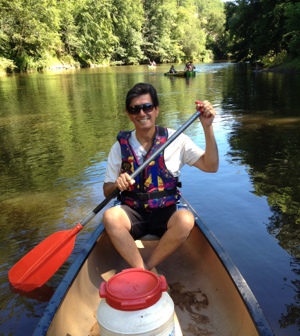
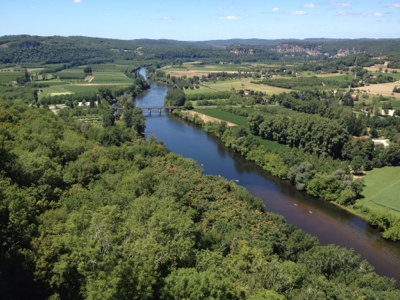
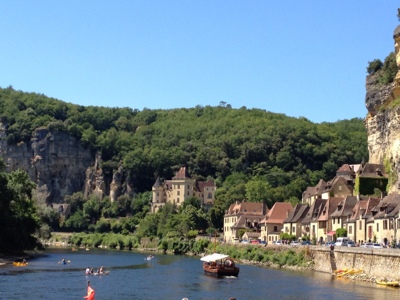
After our first canoeing experience on the Vézère, we decided we had to do it again on a scenic stretch of the Dordogne we had seen from our car earlier in the week. So we rented another canoe and set off on a 10-mile ride. One thing we find amusing about engaging in these types of activities here in France is how easy and casual it is. It’s very inexpensive compared to home at about $20 per person for 4-5 hours. They give you a life jacket, paddles, and an airtight container to keep your things dry, then lead you to a canoe. You get in and and they say, “Au revoir”. The whole process lasts 5 minutes. When we went kayaking in Ventura, it was 45 minutes before we got into the water with all the rules, precautionary advice, and instruction. Here it’s just “goodbye” and you’re gone! This time our route took us through an area filled with ancient hillside villages and imposing castles. The views were quite spectacular — really the best vantage point from which to appreciate the sights. We had a picnic with us and prepared to stop for lunch. We headed to a potential docking spot on the side of the river near La Roque Gageac we had visited previously. Unfortunately, Norman underestimated the depth of the river, so when he disembarked, he tipped the canoe and dumped us both into the water. More unfortunately, our iPhones ended up in the Dordogne with us and haven’t been the same since. Nevertheless, we found a better spot to dock the canoe, had our lunch with a beautiful view, dried out, and continued to the end of our journey. No regrets… Keeping in mind the phones are just stuff and the experience is much more valuable.

Whenever we get flustered about anything on our trip, we say to one another, “Relax. It’s a beautiful day. The sun is shining and you’re in France.” Can’t complain about that!
100 Years’ War Alive & Well

20120719-191927.jpg

This week we are spending our time in the Dordogne region of France. During the Hundred Years’ War (1336-1453), the French and the British battled it out for control of this area. Joan of Arc finally inspired the French to drive out the invaders and officially it has been theirs ever since. After a few days here, it is obvious what the fight was all about. More than any other region we have visited on our journey, this is undoubtably the most beautiful and desirable. It is lush and green and abundant with resources. One can easily understand why anyone would want to claim it. Indeed, the fight is not over. While the French have definitely been the owners of this territory for the past 600 years, the British have saved it. When the French could no longer maintain and make prosperous their small farms, the Brits bought them up and turned them into B & B’s and gîtes (with financial incentives from the the French government) welcoming everyone from around the world but most especially the English-speaking from the U.S., Australia, New Zealand, Canada, and of course, their native England. We have been the beneficiaries of this trend in our stay this week. Our hosts at Le Manoir des Granges, Paul & Philippa, are a British couple in their 50’s who bought several acres with 3 gîtes, a main house, and a house for themselves from an elderly couple who could no longer handle it about two years ago. They live here and this is now their life’s work. They have been extremely hospitable. We were welcomed on our first day with a bottle of wine and bowl of walnuts that were waiting for us in our gîte. Later in the week, they provided us with fresh-picked peaches from their orchard and scrumptious homemade walnut bread. For these and so many more reasons, we’d have to say we have enjoyed this stay more than any other on our journey.

We began our visit with a trip to La Roque Saint-Christophe which is literally across the road from our gîte. We have a stunning, floodlit view of it every evening. This limestone cliff which towers 300 feet above the road and the Vézère River has been occupied by humans for the last 50,000 years from early man through Renaissance times. Stretching for more than half a mile, it consists of 5 terraces that show remains and recreations of all the necessary elements of a Medieval/Renaissance town — church, forge, smokehouse, individual houses, and various winches that were used to haul animals and products up the cliff side — all very interesting. The view of the river and valley below is breathtaking as well. The displays and explanations encountered as you walk along the terraces make it easy to envision what life must have been like in this sheltered haven. La Roque is one of dozens of prehistoric sites in this area which is not far from the famous Lascaux Caves, home to all those cave paintings you learned about in your social studies books.

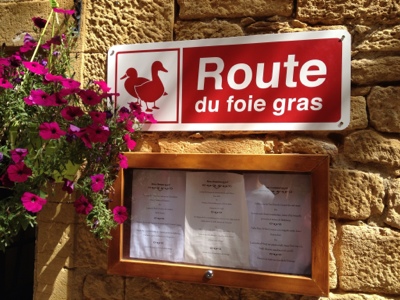
Later we ventured south along a twisty, green, forested route to Sarlat, a medieval town that was destined for abandonment and ruin in the 60’s until writer, resistance fighter, and politician, André Malraux came to its rescue. The town was restored and has become a center for tourists who visit the Dordogne. Interestingly, we learned from our hosts that many of the seemingly perfect medieval buildings are actually just façades with empty interiors which explains why we had a Disneyesque feeling as we sat with a coffee in the main town square. In fact, the town is so exclusively created for tourism that it closes up from October to March due to lack of business. One of the distinctive features of its architecture are the lauze roofs — flat limestone rocks gathered by farmers when clearing their fields and turned into cheap building material — a style which is now apparently unaffordable. With one town square dedicated to the trading of geese, it is not surprising to see more references to foie gras here than anywhere else. There are statues, murals, and paintings of geese. They adorn every object in sight and the number of stores offering goose rendered products such as foie gras are countless.

From Sarlat, we followed a 27-mile scenic loop that encompassed some of the most beautiful and picturesque towns and landscapes of the region. First stop, a spectacular viewpoint just beyond Carsac. From atop the hill you can take in the entire valley officially known as Perigord Noir, or Black Perigord, named for all its walnut trees, one of several signature products including foie gras, truffles, cheeses, wines, and sausages. Next, my favorite stop of all, Domme, a tiny hilltop village with a breathtaking view of the Dordogne River and surrounding valley laid out in emerald greens and deep blues. We stopped here for our picnic lunch and along with the view, were entertained by some idle vendors who were playing a game of pétanque in between sales. For those who don’t know, pétanque is similar to Italy’s bocce and other such games in which the object is to throw or roll heavy balls as close as possible to a smaller target ball. It is extremely popular in France. Norman has been itching to play.

20120719-192100.jpg

After tearing ourselves away from this little paradise, we moved on to La Roque Gageac, another small, charming village with an interesting story. It’s a one street town carved into a cliff across from the Dordogne River. Every winter Gageac suffers an inundation than floods the first level of all the riverfront buildings causing them to be routinely vacated. In addition to a plethora of canoes, boats called gabarres ferry tourists up and down the river. They’re modeled after boats that used to carry local wine to Bordeaux and are recognizable to many as they were used in the movie Chocolat starring Johnny Depp. Braving more steep cobblestone paths, we wound our way almost to the top level and wondered how the locals managed to navigate these every day with their cars, shopping, and belongings while at the same time putting up with tourists constantly passing by and often peeking into their homes.

The last designated stop on the trip was Beynac, yet one more perfectly preserved medieval stone village built on a hillside. At the height of the tourist season, these one street towns are just about impassable late in the day and we decided to simply take in the view from the windows of our car. Every one of these villages boasts its own castle — one more grandiose than the next. Some are privately owned and others are completely decked out in period furniture and antiques and open to the public. They are remnants of times past when noblemen used them to protect their families and control and defend surrounding territories.

20120719-192249.jpg

Time to get off the rocks and into the river! Canoeing is by far the most popular way to spend time on the water here. The Dordogne and its many tributaries provide ample opportunity. We rented a canoe and spent about three hours paddling down the lazy, smooth-flowing Vézère just beyond our gîte. The 7.5 mile trip allowed us to take in the scenery from a totally different perspective. It was spectacular to see the varied lush green vegetation rising up from the river on all sides and view the towering chateaus above us. All along the way we were accompanied by peacock-colored dragonflies skimming the water and occasionally landing on the bow of the canoe. We passed under three bridges and a number of cliff overhangs dressed in delicate ferns clinging to their undersides. At times it felt like we were on a ride at Disneyland, but it was all very real.

Like the Brits who’ve come here for the beautiful countryside, warm climate, fine foods, and plentiful, high-quality wines, we’ve been captivated by what the French sometimes call “Dordogneshire”. I am certain we will be back very soon.

Stay tuned for more Dordogne adventures as well as photos on a new link at the top of the page.

Foie Gras and the Perigord

20120718-210048.jpg

The Perigord in southwestern France is an unbelievably beautiful place. Everywhere you turn you get a picture perfect postcard view of this magnificent area. This week our accommodations are located in long valley with the Vézère River (a tributary of the Dordogne) running through it. The area is very green with hardwood trees of all sorts including one for which it is most well known — the walnut tree. There are meadows with freshly cut hay and sprouting corn fields everywhere. (Corn, by the way, is only grown for animal feed. The French think it is appalling that people would eat it.) We have a wonderful view of a 300-foot tall vertical cliff of limestone layers more than a half mile long that dominates the landscape opposite our gîte. Over eons of time, the weather has undercut the softer sections of these layers creating shelves/overhangs that have been inhabited for more than 50,000 years. Small medieval villages hug the curves of the valley. It is quiet, peaceful and beautiful.

On our way here from the Bordeaux region, we stopped in at Périgueux a fairly large city at the western beginning of this region. While it is a large city, it has a small town town feeling. While we were there, we had the opportunity to shop at the farmer’s market that only happens twice a week. We had a great time looking at all of the fresh produce available and other products like fresh breads and cheeses, olives, etc. We wound up buying most of our groceries for the week there. One of the vendors we came across was selling foie gras. For the uninitiated, that is duck or goose liver. Having had foie gras in Toulouse, I decided to buy a jar of this local delicacy.

I am a pretty adventurous person when it comes to food. I have had many things that I thought I would never be able to eat and that were perfectly acceptable to the culture that produced or invented it. From raw sea cucumbers to snails, I have been able to appreciate and honor another culture’s culinary perspective. I feel privileged to have been able to do that. Foie gras has a taste that is difficult to describe. The closest that I can come to a description has to border on poetry. It is simply heavenly. Buttery rich, with a unique indescribably delicious flavor.

Foie gras is produced by feeding corn to ducks or geese two or three times a day. A funnel is inserted into the gullet of the bird and the corn is funneled into it. This causes the liver to fatten 7-8 times its normal size. Normally, ducks and goose fatten up before the winter in order to store enough fat to insulate them from colder temperatures and to give them a source of energy when food supplies are leaner. According to the French farmers who have goose and duck farms for the production of foie gras, the birds are not harmed by this method of feeding them because their throats are tough and they do not have a gage reflex. They live until they are at least six months old versus two months for chickens that are fattened with artificial hormones in the United States in order to speed up production. Also, the geese and ducks on these farms are free to roam the large enclosures where they are kept and are relatively stress free unlike the commercial chicken farms in the U.S. where the chickens are extremely tightly caged, highly stressed, and processed mechanically so rapidly that the chicken is usually contaminated when it is packaged making it necessary to take extra care when handling it to avoid potentially harmful (and possibly fatal) bacteria.

20120718-210328.jpg

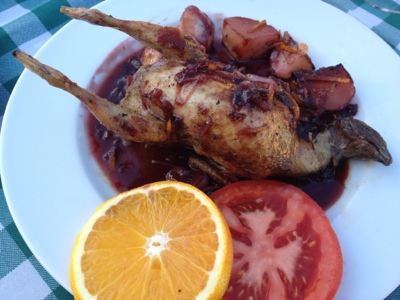
Foie gras is by far the most delicious food I have ever tasted. Nothing I can think of compares to it. It is vey rich since it is comprised mostly of fat but not in the way one might think of fat from steak, pork, or chicken. In contrast, foie gras has a creamy, buttery texture, light brown or tan in color. It can be eaten simply on a small cracker or piece of fresh baked bread. For dinner, I baked quail that were stuffed with a mixture of mushrooms, finely diced carrots, parsnip, shallots, and foie gras. A sauce of shallots, orange juice, ruby port wine, and cherry preserves thickened with a little butter accompanied the quail which were surrounded by small quartered parsnips. We had this with a local Merlot and it was (if I do say so myself) absolutely delectable. A typical jar of foie gras contains about a quarter pound and already, we have eaten about half of it. I really didn’t expect to go through it this quickly, but I can see that we will probably have to buy another jar before we leave the Perigord.

Bon appetit!

Le Mascaret

20120713-203123.jpg

This week we have spent our time in the tiny village of Asques on the banks of the Dordogne about 40 minutes east of Bordeaux. Two small torrents above the town of Mont-Dore come together to form this river — the Dore and the Dogne. Where we are located, it is a wide, muddy river which is in constant flux. Daily it rises and falls, flows west, then east and sometimes swirls in both directions at once. When we arrived on Saturday afternoon, we had the opportunity to experience one of its rare unique features — the mascaret.

Known in English as a tidal bore, the mascaret is a phenomenon that is unique to only a few rivers around the world and it does not manifest itself every day of the year. We were only able to see it once during our stay. It occurs in areas where incoming tides are funneled into a shallow, narrowing river or lake via a broad bay, in this case, the Bay of Biscay whose waters we have been following all the way from the Spanish Basque country. The tidal flow runs against the river’s natural current creating large waves twice a day suitable for surfing especially during July and August.

Large numbers of people gather at its points of greatest manifestation waiting to take advantage of the opportunity to launch a surf board, kayak, or catamaran to enjoy this thrilling experience which produces 5-10 waves — sometimes 1 kilometer in distance and lasting up to 20 minutes. We were not quite here at the prime time nor are we so adventurous as to try out such an activity on a muddy, swirling river. Nevertheless, it has been fascinating to watch the river change daily from the windows of our gîte.

We have observed many a vessel traveling the Dordogne every day — sailboats, fishing boats, barges, skips pulling surfboarders… It is obvious to us that these sailors must be very familiar with the river in order to traverse it safely. Its changing directional flow and levels, the mascaret, and all the debris the unsettled muddy water carries with it must create a challenge for any seaman.

No challenge, however, for the local Labrador who likes to play in it at its lowest level when there is a mudflat along the edge making it easily accessible to him. Earlier this week he caught Norman’s attention, grabbed a long stick and begged him to toss it into the muddy waters so he could dash in and retrieve it over and over again — naturally finding it necessary to shake off his wet, muddy coat each time he deposited the stick at Norman’s feet. You can imagine the condition they were both in after a few relays. He was never satisfied that he had enough until his owner came to admonish his behavior and send him home as if he were a small child who had escaped from his mother’s watchful eye. Great fun for both participants at the moment though!

Now it’s time to move east along the river to our next destination on one of the Dordogne’s tributaries, the Vézère, along which many of the great prehistoric caves of Southwest France are located.

For some photos and a couple of great videos of the mascaret, you might like to check out this website: KayakDordogne.com.

Also… We invite you to take a look at the new link with photos from our week here in the Gironde.

Native Son

20120712-224505.jpg

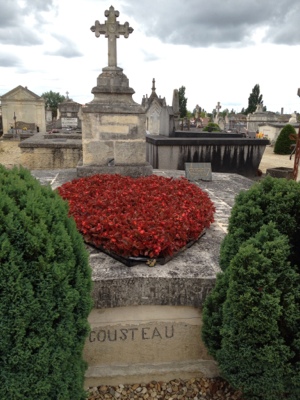
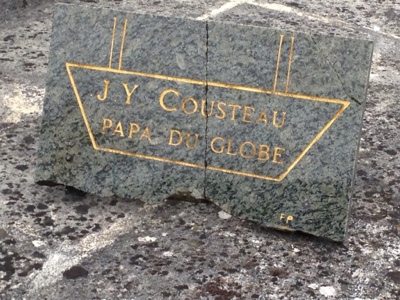
One of the advantages of living your vacation in the slow lane is that you discover things you would not normally learn about at a faster pace. Saint-André-de-Cubzac is the closest town to our little village (about 15 minutes away) where we go for groceries, a boulangerie, gas, or a bank. In researching available services in the area, I stumbled across an interesting fact. It turns out that the legendary Jacques Cousteau was born there and is buried in the Cousteau family plot in Saint André’s cemetery. So, today, on our way to do some shopping, we made a small detour to visit his gravesite.

As I’m sure most of you know, Cousteau was a French naval officer, explorer, conservationist, filmmaker, innovator, scientist, photographer, author, and researcher who studied the sea and all forms of life in water. He co-developed the Aqua-Lung and pioneered marine conservation. He was born in Saint-André-de-Cubzac on June 11, 1910. Shortly after his birth, his family moved to Paris where his father worked as a lawyer. Jacques was a sickly child and was instructed not to participate in strenuous activities, but, nevertheless, he learned how to swim and eventually developed a love for the sea. Though he did not do particularly well in school, he succeeded in being admitted to and graduating from the French naval academy and entering the navy where he was given a pair of goggles used by divers. This piqued his curiosity. His fascination with the ability to see underwater led to his interest in developing a device that would allow humans to breathe underwater.

With the advent of WW II in 1939, Cousteau’s research was put on hold while he carried out his naval assignment as a gunnery officer and participated in the French Resistance. Ironically, his brother, Pierre-Antoine, was a pro-Nazi war criminal at one time sentenced to death until he was released under an amnesty agreement in 1954. Due to their extreme political differences, the two brothers became estranged.

In 1937, Cousteau married and had two sons, Jean-Michael and Philippe who was his favorite and chosen to carry on the family business and oceanographic legacy. Unfortunately, Philippe died in a helicopter accident at the age of 38 prompting Cousteau to form an alliance with his oldest son with whom he collaborated for 14 years. During this same period, he had an affair and two more children with another woman who eventually became his wife after the death of his first wife from cancer. Today she continues her husband’s work as head of the Cousteau Foundation and Cousteau Society, two non-profit organizations that promote underwater exploration and ecology.

Professionally, Cousteau carried out countless hours of underwater field research and archaeological explorations on the infamous ship Calypso which would have been impossible without scuba gear including the Aqua-Lung that he developed and pioneered. This apparatus gave him the ability to explore and film parts of the ocean that had never been seen before which he shared with the world through his many films and television specials. In addition, he was personally responsible for bringing an awareness to many of the practices which endangered ocean life such as whaling and the disposal of nuclear waste. Along the way he garnered many awards and titles such as the U.S. Presidential Medal of Freedom and the French Legion of Honor, but he will most notably be recognized by all for taking us into the depths of the ocean for the very first time.

20120712-224615.jpg

Cousteau died of a heart attack in 1997 at the age of 87. He was buried in the family plot in Saint-André-de-Cubzac. The city paid homage to him with the inauguration of the Rue du Commandant Cousteau, a street which runs out to his native house, where a commemorative plaque is affixed. The plot is a simple raised stone structure typical of those in any French cemetery bearing a small and aged commemorative plaque which reads, “J. Y. Cousteau / Papa du Globe”. Situated on top and distinguishing it from the myriad of other plots is a large heart-shaped arrangement of red begonias, the only fresh flowers in the whole cemetery — an obvious sign that Saint-André has not forgotten Jacques-Yves Cousteau. As you leave the cemetery, you circle one of the usual French roundabouts where you immediately notice that a dolphin is mounted in the center with a familiar red diver’s cap in his beak — one more quiet and eloquent reminder of the city’s native son.

Napa on Steroids

20120711-174144.jpg

If you have ever been to the Napa Valley for the experience of wine tasting, you know how this scene goes. You drive down one of two main roads through the area and every few miles you find a winery where you can stop in, taste the wines, and perhaps take a tour. Even though it’s supposed to be wine tasting not drinking, you can’t really plan to hit more than two or three wineries in a day. First of all, after a while your tastebuds give out and all wines taste the same. Secondly, and maybe more importantly, you won’t be able to make it back to your hotel safely unless you have a designated driver. Over the years, we have made several trips to Napa, Sonoma, and the Russian River areas and now, of course, they are right in our backyard. We are quite familiar with the experience and have truthfully had our “fill” of it. While we enjoyed these various degustations, as they’re called in France, we discovered that the wine we especially liked at the winery (and, in some cases, put out some serious money for) did not impress us nearly as much once we got it home. I’ve come to the conclusion that the vintners and sommeliers have done a good job of learning how to promote their business so as to convince you that their wine is the best.

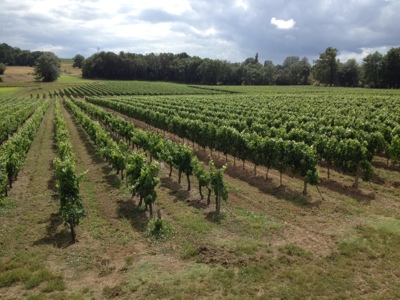
We really satisfied our French wine tasting desires during our stay in Beaune, the heart of Burgundy wine country, at Patriarche et Fils where, by the way, we did not buy any wine. Since, as we’ve mentioned in previous posts, the French standard for wine is so high, we have been able to find an excellent variety of local area wines by simply shopping for them at the grocery store in each place we have stayed. We simply look for wines that have earned the gold medal distinction. Why not chose a wine that has received France’s own highest award? So this week when we landed smack dab in the middle of the Bordeaux wine country surrounded by vineyards in every direction, we were not motivated to add visiting the chateaus to our “to do” list. In fact, this week we have had no “to do” list at all. Our only desire has been to kick back and relax.

Today, however, we thought we should venture out for at least a few hours and check out our environment. I scoured the many brochures previous guests have left behind, read through my digital guidebooks, and perused the Internet. Finally I decided on a drive to Saint Émilion, only about 30 minutes away. We hear a lot about Saint Émilion wines in the U.S. but they’re not commonly stocked in our stores. As we progressed on our journey, we found ourselves bombarded by one chateau after another so close together on the narrow, winding road that it would cause an accident if you decided to stop and visit one. That’s when I commented, “This is like Napa on steroids!” It was really crazy to see the endless number of wineries. In fact, there are 13,000 wine producers in this area, the biggest concentration of wine-producing vineyards in the world. Since it’s summer and the height of the tourist season, a few of these places were actually advertising that they were open for tasting, but in reality, for most of them, you have to make an appointment because most vineyards don’t have permanent staff to accommodate tourists.

20120711-174307.jpg

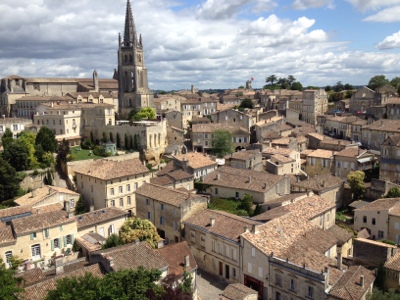
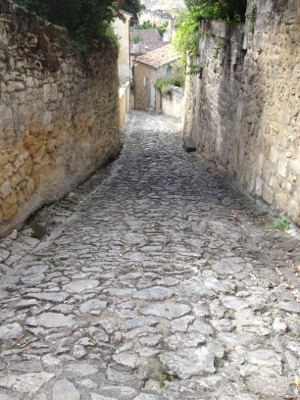
Saint-Émilion sits on a limestone plateau overlooking the Dordogne Valley. It is small village dating back to the Middle Ages boasting several large monuments including the Tour du Roi, or king’s Keep, a fortified tower constructed as part of a castle which served among other things as the last resort for resistance against attacking parties — a place to keep the king and his family safe. Norman took advantage of the opportunity to climb to the top of the tower, enjoy the views of the valley below, and capture a few photos. (Too many stairs and claustrophobic passages for me.) Navigating the town requires ascending/descending extremely uneven and steep cobblestone streets and alleyways. NO! Not more cobblestones! Fortunately, unlike several women I saw, I was not wearing heels. The village owes its name to yet another infamous monk, St. Émilion who established a hermitage in a cave in the 8th century. The monks who followed him dug a subterranean church on this site and began the commercialization of the wine industry in the area which I guess is a good thing because aside from visiting (yet another) old monument, the only other thing to do is taste and buy wine. Just like the never ending string of wineries along the road we saw on the way in, the streets of Saint-Émilion are packed with wine shops. Some of these with their wares carefully organized and displayed and others that seem to have rented space and simply thrown in boxes of their latest vintage. As for eating, the town council has obviously banned smaller establishments to the outskirts of town so that all you encounter on your walk is an array of expensive restaurants. All this reminded us of someplace we’d rather not be. Kind of ironic that we weren’t inclined to spend any money here in light of an article I read about the town during my research…

Saint-Émilion is on the list of UNESCO’s World Heritage sites. Last year, the mayor was forced to sell off one of its historical monuments, the Cordeliers cloisters, in order to pay off some debts. The town has a debt load four times greater than the average French town of the same size despite tax revenues which are 73 per cent higher. Some of this is attributed to poor management, but the town council claims that the sale was necessary to maintain the historical sites. The cloisters sold for 750,000€ (about $930,000) after the town spent 570,000€ ($698,000) to restore it. The new owner… head of a sparkling wine company, of course, which is housed in the facility.

As usual, each of our adventures adds to our understanding of France — the people, the country, and its history. This one was no exception.

Invasions, Evasion, and the Tapette à Mouche

20120710-232729.jpg

France, like many European countries, has endured centuries of invasions from the Romans, Gauls, or neighboring clans to the Italians, Germans and the Brits. You can see evidence of this anywhere you go in the form of fortified castles, walled citadels, and enclosed monasteries. France (and the French) have repeatedly tried to keep out whatever was trying to get in.

Our tour throughout France has been a varied one. We have stayed in large cities and very small villages (where the population of our most recent stay is 476). Everywhere we have stayed, we have encountered stone houses that are clustered very close to each other. Many times a one-lane road is the only thing that separates one building from another with no sidewalk or front patio or porch. This has puzzled us to no end. Even in places that are surrounded by large tracts of land, the village houses are clustered tightly together. Another puzzling aspect of life in France is the fact that in most of the older sections of a city or village, the houses seem to have no front façade. Instead, you encounter building after building that seem to have no front to them at all. It is as if you were looking at the back of a building facing the street. Everywhere you look, there are no trees, vegetation, or greenery of any kind. Just stone or brick.

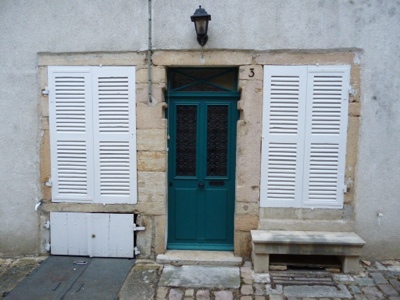
Another puzzle is that just about every single stone house you see has heavy wood shutters on the exterior of the building. The shutters are not only on the windows but can be on the front door as well. And while the windows and doors may have glass windows that swing in or out, everywhere we look, the heavy wood shutters are tightly closed, or at the most, just slightly open. In every place we have stayed that has had shutters, we have been the only ones to open the shutters (and windows) completely. We love to have light come into the living area and when not enough light would come in because the windows were too small or because the building was facing north, we missed the light. Oh, yes, by the way, every evening, way before the sun is even thinking of setting, everyone (except for us, of course) has shuttered themselves tightly into their homes.

So what gives? Why are buildings so tightly packed together even when there is a lot of space all around? And why are there no sidewalks to walk on, or shutters that are mostly closed, and buildings that seem to turn their backs to you? And where are the trees, flowers, and grass?

Perhaps centuries of invasions by one group or another have led to towns and villages that are tightly packed so that it would be easier to defend than one where there was a lot of room between buildings. After all, many of the towns and villages we have been to are centuries old. As for the narrow streets and no sidewalks? Most stone buildings were built centuries before the invention of the car, so any street or alley was meant for pedestrians or ox and cart.

As for the shutters, according to authors Jean-Benoit Nadeau & Julie Barlow (Sixty Million Frenchmen Can’t Be Wrong: Why We Love France but not the French), shutters first started appearing over four hundred years ago after the ruling class (noblemen, barons etc.) started taxing common people according to how much perceived wealth one had. This “estimate” of one’s wealth was determined by looking into people’s homes through their windows. So the idea to shutter the windows away from the prying eyes of the tax man was born.

There seem to be certain things that remain in the French mentality. Shutters come to mind. And why no trees, grass or flowers? The French, like the Spaniards, build their homes so that the outside living area (i.e., the yard), is enclosed as a courtyard within the confines of the building. This makes their homes very private places where they can have as simple or elegant a courtyard as they wish.

One last note, I surmise that one of the reasons the French keep all of their windows closed even when their shutters are open is because, since there are no screens on the windows (which would make it next to impossible to close the shutters), keeping the windows closed keeps out any unwanted flying bugs like flies and mosquitoes. Since we love the fresh air and sunlight, we have had a few of the offending bugs enter, uninvited of course. So what is the solution? Mr. BigFoot! It seems that the French deal with flies and mosquitos by not letting them into the house in the first place….hence, they close (and keep closed) all the windows. Since we are just the opposite, I have had to look for (and let me tell you, it took a lot of looking) a fly swatter! Very rare to find one it seems. What I did manage to buy (I suspect only because it is summertime), is a very thin, flimsy foot-shaped plastic swatter… “Mr. BigFoot” I call it or, as the French would say, a tapette à mouche.

The French Bar

While France is definitely renowned for its fine wines, they’re not the only thing on the bar menu. In fact, each region has its own cocktail specialty. So if you’re in the mood for a different kind of refreshing drink on a warm summer’s day, here are some recipes you might like to try.

20120709-174412.jpg

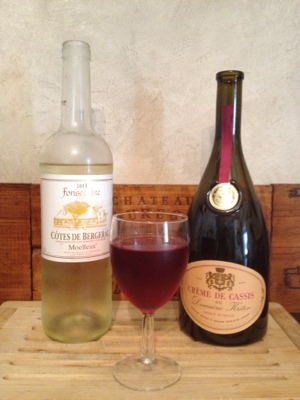
KIR – Burgundy
This drink was popularized by Felix Kir, mayor of Dijon & hero of the French Resistance, just after WW II in order to showcase his region’s fine products — wine and Crème de Cassis, a black current liqueur. Kir is a favorite drink of Agatha Christie’s fictional detective, Hercule Poirot. It is simple to make and has many variations.

Ingredients:

  • 1/2 oz. Crème de Cassis
  • 5-6 oz. dry white wine (i.e. Chardonnay)

Directions:
Pour the Crème de Cassis into a wine glass. Add the dry white wine. Garnish with a lemon twist.
*I prefer to chill the wine first.

Kir Royale – substitute champagne for the wine

We picked up a locally produced Cassis in Beaune at the winery we toured which we have found to be especially good. If you can find (and afford) a French brand, you will discover it is much richer and thicker than the American style most readily available in the U.S.

20120709-174504.jpg

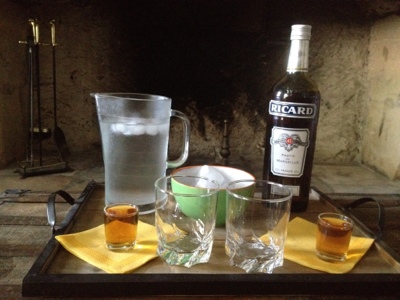
PASTIS – Provence
If you like anise-flavored drinks, this one’s for you. Pastis was developed by Paul Ricard in 1932 as an alternate to absinthe, the drink of many Parisian artists & writers in the early 1900’s, which was extremely addictive in its original form and hence, was banned. Unlike absinthe, Pastis is derived from the distillation of star anise with the addition of licorice root. As it is 45% alcohol, it is always diluted with water. Though uncommon in the U.S., it is one of the most popular beverages in France with 130 million liters sold each year.

How to Drink Pastis:

  • Pour 1 oz. of Pastis into a rocks glass.
  • Add 5 oz. of water, preferably chilled.
  • Top with ice cubes as desired.
  • Sip slowly.

Pastis is meant to be enjoyed by itself not as an accompaniment to food. When served in a restaurant, the waiter will often bring the ingredients separately — a glass, a shot of Pastis, a pitcher of water, and a bowl of ice (to be combined in that order) — as everyone has their own preference for the intensity of the anise. Curiously, the addition of water causes the liqueur to change from clear yellow to a milky pale yellow due to the insolubility of some of its contents.

For more info: Ricard Pastis

20120709-174526.jpg

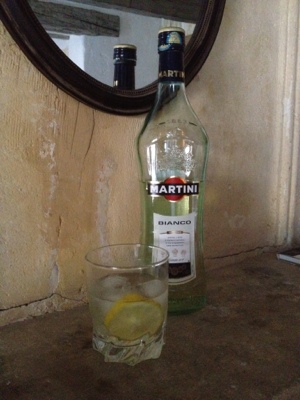
MARTINI – Not James Bond’s Order

We discovered this on a menu at our B & B in Talloires in the Alps region. Our first thought was that it was one of the “shaken, not stirred” variety, but when we inquired we found that it was something completely different. It was a simple aperitif created with Martini, an Italian vermouth, of Martini & Rossi fame. Super easy & very refreshing enjoyed before or with a meal.

How to Serve Martini:

Pour 3 oz. over ice into a rocks glass. Add a twist of lime or lemon.
*Martini comes in Bianco, Rosso, and Rosato. We prefer the Bianco.

For more info: Martini

To all our friends, family, and faithful readers… as they say here in France, “Salut!”

From Schubert to Beethoven

20120709-121653.jpg

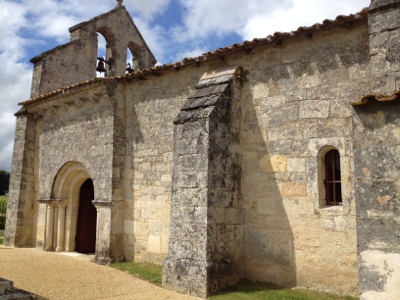
We are staying this week in a small village that cozies up to the banks of the Dordogne river in the Bordeaux wine growing region. Asques, like small and large cities throughout France, is enjoying a national summer concert series — the12th year for this series. Last night and this evening, we decided to attend two local concerts to listen to the classical music programs being offered. Asques is a small village and has an old roman church at the top of a small hill that overlooks the village and the Dordogne river. Last night’s concert was held inside. The inside of this church is very simple consisting of two elongated barrel vaults sitting side by side about 50 feet in length each. The adjoining vaults are supported by two simple Roman arches. The interior walls are barren except for the statues of Mary and Christ, and a small stained glass window here and there.
The concert presentation that evening was Opus 100 by Franz Schubert. The instrumentation consisted of piano, violin and cello.

Having played concert bass in school orchestras from junior high and into college, I am familiar with many of the classical composers and I wanted Cheryl to have the experience of attending something that the local people would themselves attend. As it turned out, we were the only non-locals there.

The musicians were set up in the middle of the church and seating was available in a half circle around them. The setting couldn’t have been more intimate. Surrounded by the village locals, we settled in. When the musicians started playing, we were startled to hear rich, vibrant tones coming from their instruments. At first, I thought they surely must be miked. Surprisingly, they weren’t. The acoustics of this small chapel were amazing! You could hear every nuance that the exceptionally talented musicians played. It was incredible and a joy to listen to.

This evening we attended the other concert, Beethoven. The concert location was in the village of Mouillac, a short drive from Asques. As before, the concert was held in a small Roman church. This church, however, was about half the size of the previous one and was much more an example of ancient Roman architecture. At first, I was wondering how the musicians (a septet of violin, viola, cello, concert bass, French horn, bassoon, and clarinet) plus any audience could possibly fit into such a small space. The interior of this chapel was very simple, almost stark with few adornments of any kind, no windows, and the entire structure was a single barrel vault. The seven musicians sat at one end while the audience was, once again, seated in a semi-circle around them. The musicians were highly skilled professionals. Most were in their early thirties although we suspected that one or two were younger. Listening to the stringed instruments in such close proximity and with the acoustics of the chapel, made you appreciate the quality of the sound, the expressive inflection of every tone, and the crisp richness of every note. It was a wonderful experience and one that we will carry with us for a long time.

One of the things that we noticed and remarked to each about was the fact that in both concerts there were children. Not many but those who were present were about 3 and 4 years old. Not once during the two hour concert, including pauses lasting up to a minute between musical passages, did any of these children, talk, fidget, or make ANY disturbance of any kind! We were amazed! They simply sat next to their parents, quietly played with a toy, and slept if they felt like it. The adults (including yours trulies), showed the utmost respect for the musicians. Not a sound was heard from the audience to detract from the exceptional quality of the musicianship. The audience also held their very appreciative applause until the end of the presentation.

20120709-121827.jpg

The wonderful thing about traveling is when you discover traditions, customs, or behaviors in the local culture that are different from yours. Cheryl noticed that when the audience applauded, at first it sounded just like any other applause. But after a minute or two, there came a rhythm to it in the form of 3’s with a short pause between the next three. The musicians would exit and return to acknowledge the applause three times. This happened at both concerts.

The summer concert series for this area is over until later in the summer. We hope to catch other concerts series at our next location.

Ritzy Biarritz

20120708-135305.jpg

Biarritz — by my definition AKA:

  • Mini Montecarlo
  • Palm Springs with a Beach
  • Money, Money, Money ( you need it to be there or you can try to win it at the casino)
  • Lifestyles of the Rich and Famous (remember that show?)

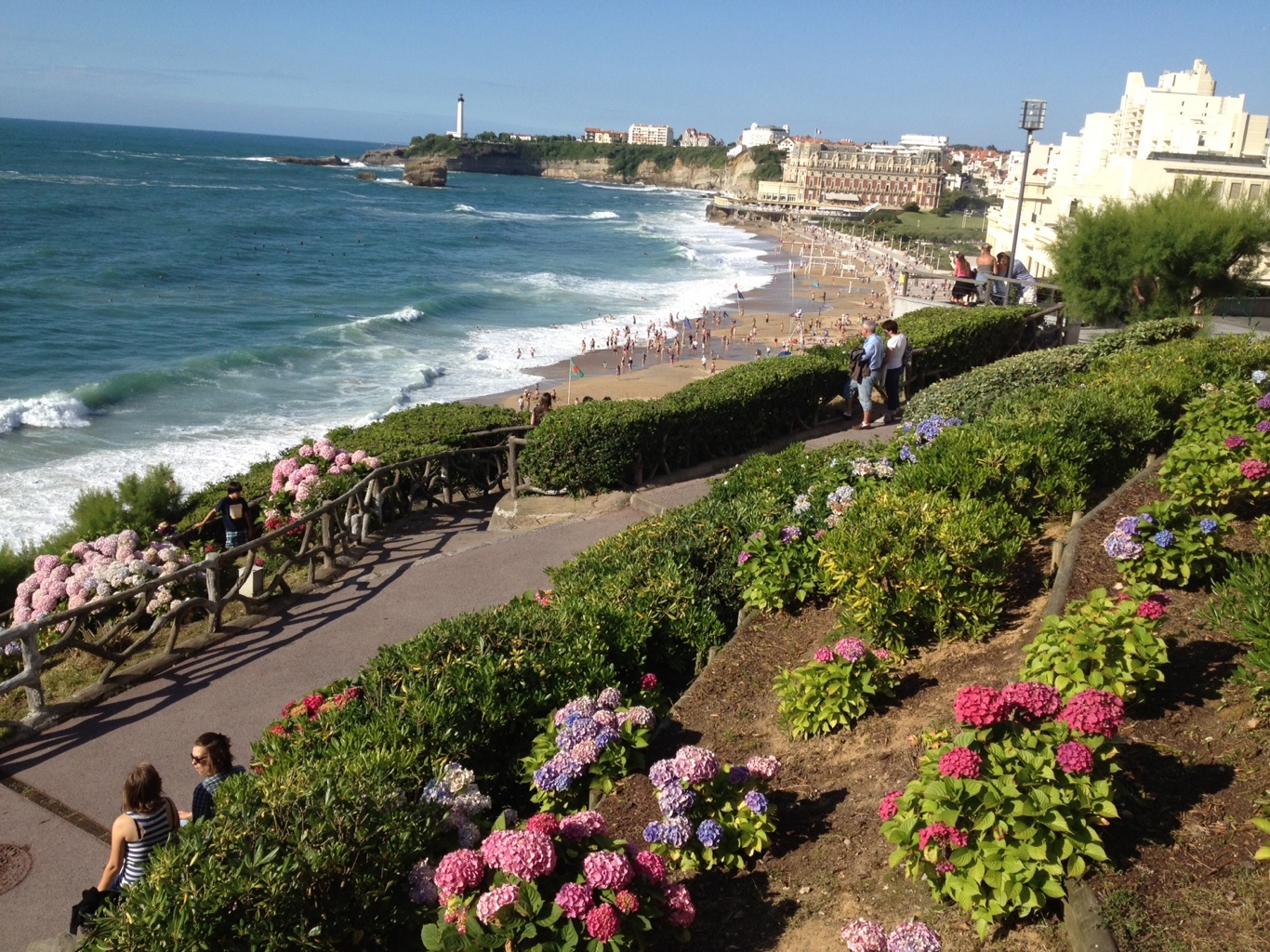
(Wikipedia) …a Basque city which lies on the Bay of Biscay on the Atlantic coast in south-western France. It is a luxurious seaside town and is popular with tourists and surfers.

This was a one-night stopover in our transition back into France on the way to Bordeaux. Unfortunately, nothing remarkable for us as we felt we had been to many touristy places like this, but we had a great “hotel picnic” and a good night’s rest before moving on.

Post Navigation