Paris and Beyond

Our Personal Tour de France & Other Exciting Adventures!

Archive for the month “July, 2012”

Native Son

20120712-224505.jpg

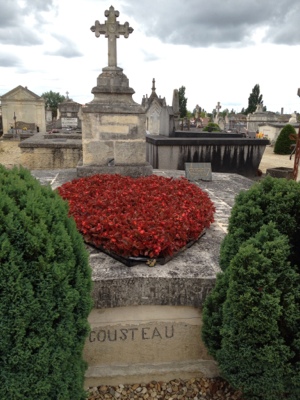
One of the advantages of living your vacation in the slow lane is that you discover things you would not normally learn about at a faster pace. Saint-André-de-Cubzac is the closest town to our little village (about 15 minutes away) where we go for groceries, a boulangerie, gas, or a bank. In researching available services in the area, I stumbled across an interesting fact. It turns out that the legendary Jacques Cousteau was born there and is buried in the Cousteau family plot in Saint André’s cemetery. So, today, on our way to do some shopping, we made a small detour to visit his gravesite.

As I’m sure most of you know, Cousteau was a French naval officer, explorer, conservationist, filmmaker, innovator, scientist, photographer, author, and researcher who studied the sea and all forms of life in water. He co-developed the Aqua-Lung and pioneered marine conservation. He was born in Saint-André-de-Cubzac on June 11, 1910. Shortly after his birth, his family moved to Paris where his father worked as a lawyer. Jacques was a sickly child and was instructed not to participate in strenuous activities, but, nevertheless, he learned how to swim and eventually developed a love for the sea. Though he did not do particularly well in school, he succeeded in being admitted to and graduating from the French naval academy and entering the navy where he was given a pair of goggles used by divers. This piqued his curiosity. His fascination with the ability to see underwater led to his interest in developing a device that would allow humans to breathe underwater.

With the advent of WW II in 1939, Cousteau’s research was put on hold while he carried out his naval assignment as a gunnery officer and participated in the French Resistance. Ironically, his brother, Pierre-Antoine, was a pro-Nazi war criminal at one time sentenced to death until he was released under an amnesty agreement in 1954. Due to their extreme political differences, the two brothers became estranged.

In 1937, Cousteau married and had two sons, Jean-Michael and Philippe who was his favorite and chosen to carry on the family business and oceanographic legacy. Unfortunately, Philippe died in a helicopter accident at the age of 38 prompting Cousteau to form an alliance with his oldest son with whom he collaborated for 14 years. During this same period, he had an affair and two more children with another woman who eventually became his wife after the death of his first wife from cancer. Today she continues her husband’s work as head of the Cousteau Foundation and Cousteau Society, two non-profit organizations that promote underwater exploration and ecology.

Professionally, Cousteau carried out countless hours of underwater field research and archaeological explorations on the infamous ship Calypso which would have been impossible without scuba gear including the Aqua-Lung that he developed and pioneered. This apparatus gave him the ability to explore and film parts of the ocean that had never been seen before which he shared with the world through his many films and television specials. In addition, he was personally responsible for bringing an awareness to many of the practices which endangered ocean life such as whaling and the disposal of nuclear waste. Along the way he garnered many awards and titles such as the U.S. Presidential Medal of Freedom and the French Legion of Honor, but he will most notably be recognized by all for taking us into the depths of the ocean for the very first time.
20120712-224615.jpg

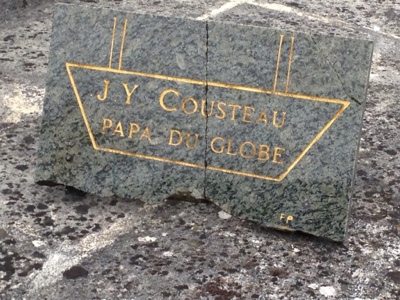
Cousteau died of a heart attack in 1997 at the age of 87. He was buried in the family plot in Saint-André-de-Cubzac. The city paid homage to him with the inauguration of the Rue du Commandant Cousteau, a street which runs out to his native house, where a commemorative plaque is affixed. The plot is a simple raised stone structure typical of those in any French cemetery bearing a small and aged commemorative plaque which reads, “J. Y. Cousteau / Papa du Globe”. Situated on top and distinguishing it from the myriad of other plots is a large heart-shaped arrangement of red begonias, the only fresh flowers in the whole cemetery — an obvious sign that Saint-André has not forgotten Jacques-Yves Cousteau. As you leave the cemetery, you circle one of the usual French roundabouts where you immediately notice that a dolphin is mounted in the center with a familiar red diver’s cap in his beak — one more quiet and eloquent reminder of the city’s native son.
Napa on Steroids

20120711-174144.jpg

If you have ever been to the Napa Valley for the experience of wine tasting, you know how this scene goes. You drive down one of two main roads through the area and every few miles you find a winery where you can stop in, taste the wines, and perhaps take a tour. Even though it’s supposed to be wine tasting not drinking, you can’t really plan to hit more than two or three wineries in a day. First of all, after a while your tastebuds give out and all wines taste the same. Secondly, and maybe more importantly, you won’t be able to make it back to your hotel safely unless you have a designated driver. Over the years, we have made several trips to Napa, Sonoma, and the Russian River areas and now, of course, they are right in our backyard. We are quite familiar with the experience and have truthfully had our “fill” of it. While we enjoyed these various degustations, as they’re called in France, we discovered that the wine we especially liked at the winery (and, in some cases, put out some serious money for) did not impress us nearly as much once we got it home. I’ve come to the conclusion that the vintners and sommeliers have done a good job of learning how to promote their business so as to convince you that their wine is the best.

We really satisfied our French wine tasting desires during our stay in Beaune, the heart of Burgundy wine country, at Patriarche et Fils where, by the way, we did not buy any wine. Since, as we’ve mentioned in previous posts, the French standard for wine is so high, we have been able to find an excellent variety of local area wines by simply shopping for them at the grocery store in each place we have stayed. We simply look for wines that have earned the gold medal distinction. Why not chose a wine that has received France’s own highest award? So this week when we landed smack dab in the middle of the Bordeaux wine country surrounded by vineyards in every direction, we were not motivated to add visiting the chateaus to our “to do” list. In fact, this week we have had no “to do” list at all. Our only desire has been to kick back and relax.

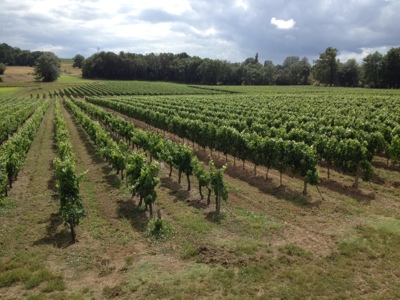
Today, however, we thought we should venture out for at least a few hours and check out our environment. I scoured the many brochures previous guests have left behind, read through my digital guidebooks, and perused the Internet. Finally I decided on a drive to Saint Émilion, only about 30 minutes away. We hear a lot about Saint Émilion wines in the U.S. but they’re not commonly stocked in our stores. As we progressed on our journey, we found ourselves bombarded by one chateau after another so close together on the narrow, winding road that it would cause an accident if you decided to stop and visit one. That’s when I commented, “This is like Napa on steroids!” It was really crazy to see the endless number of wineries. In fact, there are 13,000 wine producers in this area, the biggest concentration of wine-producing vineyards in the world. Since it’s summer and the height of the tourist season, a few of these places were actually advertising that they were open for tasting, but in reality, for most of them, you have to make an appointment because most vineyards don’t have permanent staff to accommodate tourists.

20120711-174307.jpg

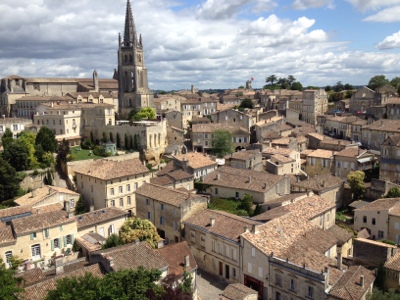
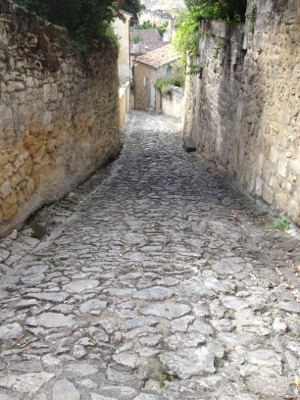
Saint-Émilion sits on a limestone plateau overlooking the Dordogne Valley. It is small village dating back to the Middle Ages boasting several large monuments including the Tour du Roi, or king’s Keep, a fortified tower constructed as part of a castle which served among other things as the last resort for resistance against attacking parties — a place to keep the king and his family safe. Norman took advantage of the opportunity to climb to the top of the tower, enjoy the views of the valley below, and capture a few photos. (Too many stairs and claustrophobic passages for me.) Navigating the town requires ascending/descending extremely uneven and steep cobblestone streets and alleyways. NO! Not more cobblestones! Fortunately, unlike several women I saw, I was not wearing heels. The village owes its name to yet another infamous monk, St. Émilion who established a hermitage in a cave in the 8th century. The monks who followed him dug a subterranean church on this site and began the commercialization of the wine industry in the area which I guess is a good thing because aside from visiting (yet another) old monument, the only other thing to do is taste and buy wine. Just like the never ending string of wineries along the road we saw on the way in, the streets of Saint-Émilion are packed with wine shops. Some of these with their wares carefully organized and displayed and others that seem to have rented space and simply thrown in boxes of their latest vintage. As for eating, the town council has obviously banned smaller establishments to the outskirts of town so that all you encounter on your walk is an array of expensive restaurants. All this reminded us of someplace we’d rather not be. Kind of ironic that we weren’t inclined to spend any money here in light of an article I read about the town during my research…

Saint-Émilion is on the list of UNESCO’s World Heritage sites. Last year, the mayor was forced to sell off one of its historical monuments, the Cordeliers cloisters, in order to pay off some debts. The town has a debt load four times greater than the average French town of the same size despite tax revenues which are 73 per cent higher. Some of this is attributed to poor management, but the town council claims that the sale was necessary to maintain the historical sites. The cloisters sold for 750,000€ (about $930,000) after the town spent 570,000€ ($698,000) to restore it. The new owner… head of a sparkling wine company, of course, which is housed in the facility.

As usual, each of our adventures adds to our understanding of France — the people, the country, and its history. This one was no exception.

Invasions, Evasion, and the Tapette à Mouche

20120710-232729.jpg

France, like many European countries, has endured centuries of invasions from the Romans, Gauls, or neighboring clans to the Italians, Germans and the Brits. You can see evidence of this anywhere you go in the form of fortified castles, walled citadels, and enclosed monasteries. France (and the French) have repeatedly tried to keep out whatever was trying to get in.

Our tour throughout France has been a varied one. We have stayed in large cities and very small villages (where the population of our most recent stay is 476). Everywhere we have stayed, we have encountered stone houses that are clustered very close to each other. Many times a one-lane road is the only thing that separates one building from another with no sidewalk or front patio or porch. This has puzzled us to no end. Even in places that are surrounded by large tracts of land, the village houses are clustered tightly together. Another puzzling aspect of life in France is the fact that in most of the older sections of a city or village, the houses seem to have no front façade. Instead, you encounter building after building that seem to have no front to them at all. It is as if you were looking at the back of a building facing the street. Everywhere you look, there are no trees, vegetation, or greenery of any kind. Just stone or brick.

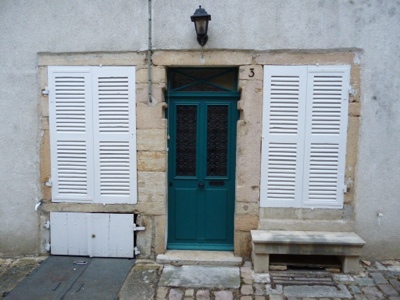
Another puzzle is that just about every single stone house you see has heavy wood shutters on the exterior of the building. The shutters are not only on the windows but can be on the front door as well. And while the windows and doors may have glass windows that swing in or out, everywhere we look, the heavy wood shutters are tightly closed, or at the most, just slightly open. In every place we have stayed that has had shutters, we have been the only ones to open the shutters (and windows) completely. We love to have light come into the living area and when not enough light would come in because the windows were too small or because the building was facing north, we missed the light. Oh, yes, by the way, every evening, way before the sun is even thinking of setting, everyone (except for us, of course) has shuttered themselves tightly into their homes.

So what gives? Why are buildings so tightly packed together even when there is a lot of space all around? And why are there no sidewalks to walk on, or shutters that are mostly closed, and buildings that seem to turn their backs to you? And where are the trees, flowers, and grass?

Perhaps centuries of invasions by one group or another have led to towns and villages that are tightly packed so that it would be easier to defend than one where there was a lot of room between buildings. After all, many of the towns and villages we have been to are centuries old. As for the narrow streets and no sidewalks? Most stone buildings were built centuries before the invention of the car, so any street or alley was meant for pedestrians or ox and cart.

As for the shutters, according to authors Jean-Benoit Nadeau & Julie Barlow (Sixty Million Frenchmen Can’t Be Wrong: Why We Love France but not the French), shutters first started appearing over four hundred years ago after the ruling class (noblemen, barons etc.) started taxing common people according to how much perceived wealth one had. This “estimate” of one’s wealth was determined by looking into people’s homes through their windows. So the idea to shutter the windows away from the prying eyes of the tax man was born.

There seem to be certain things that remain in the French mentality. Shutters come to mind. And why no trees, grass or flowers? The French, like the Spaniards, build their homes so that the outside living area (i.e., the yard), is enclosed as a courtyard within the confines of the building. This makes their homes very private places where they can have as simple or elegant a courtyard as they wish.

One last note, I surmise that one of the reasons the French keep all of their windows closed even when their shutters are open is because, since there are no screens on the windows (which would make it next to impossible to close the shutters), keeping the windows closed keeps out any unwanted flying bugs like flies and mosquitoes. Since we love the fresh air and sunlight, we have had a few of the offending bugs enter, uninvited of course. So what is the solution? Mr. BigFoot! It seems that the French deal with flies and mosquitos by not letting them into the house in the first place….hence, they close (and keep closed) all the windows. Since we are just the opposite, I have had to look for (and let me tell you, it took a lot of looking) a fly swatter! Very rare to find one it seems. What I did manage to buy (I suspect only because it is summertime), is a very thin, flimsy foot-shaped plastic swatter… “Mr. BigFoot” I call it or, as the French would say, a tapette à mouche.

The French Bar

While France is definitely renowned for its fine wines, they’re not the only thing on the bar menu. In fact, each region has its own cocktail specialty. So if you’re in the mood for a different kind of refreshing drink on a warm summer’s day, here are some recipes you might like to try.

20120709-174412.jpg

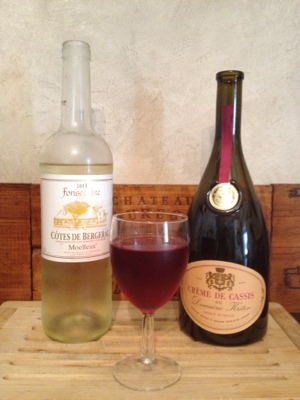
KIR – Burgundy
This drink was popularized by Felix Kir, mayor of Dijon & hero of the French Resistance, just after WW II in order to showcase his region’s fine products — wine and Crème de Cassis, a black current liqueur. Kir is a favorite drink of Agatha Christie’s fictional detective, Hercule Poirot. It is simple to make and has many variations.

Ingredients:

  • 1/2 oz. Crème de Cassis
  • 5-6 oz. dry white wine (i.e. Chardonnay)

Directions:
Pour the Crème de Cassis into a wine glass. Add the dry white wine. Garnish with a lemon twist.
*I prefer to chill the wine first.

Kir Royale – substitute champagne for the wine

We picked up a locally produced Cassis in Beaune at the winery we toured which we have found to be especially good. If you can find (and afford) a French brand, you will discover it is much richer and thicker than the American style most readily available in the U.S.

20120709-174504.jpg

PASTIS – Provence
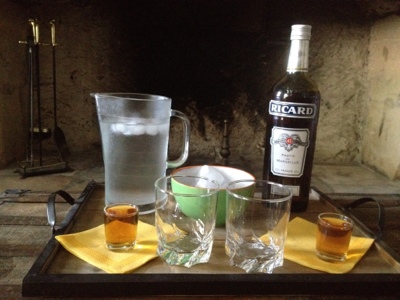
If you like anise-flavored drinks, this one’s for you. Pastis was developed by Paul Ricard in 1932 as an alternate to absinthe, the drink of many Parisian artists & writers in the early 1900’s, which was extremely addictive in its original form and hence, was banned. Unlike absinthe, Pastis is derived from the distillation of star anise with the addition of licorice root. As it is 45% alcohol, it is always diluted with water. Though uncommon in the U.S., it is one of the most popular beverages in France with 130 million liters sold each year.

How to Drink Pastis:

  • Pour 1 oz. of Pastis into a rocks glass.
  • Add 5 oz. of water, preferably chilled.
  • Top with ice cubes as desired.
  • Sip slowly.

Pastis is meant to be enjoyed by itself not as an accompaniment to food. When served in a restaurant, the waiter will often bring the ingredients separately — a glass, a shot of Pastis, a pitcher of water, and a bowl of ice (to be combined in that order) — as everyone has their own preference for the intensity of the anise. Curiously, the addition of water causes the liqueur to change from clear yellow to a milky pale yellow due to the insolubility of some of its contents.

For more info: Ricard Pastis

20120709-174526.jpg

MARTINI – Not James Bond’s Order

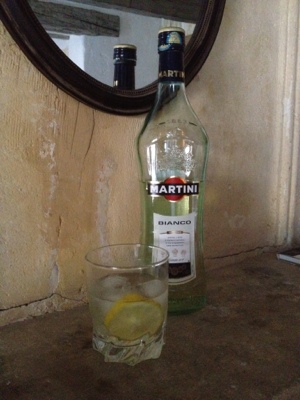
We discovered this on a menu at our B & B in Talloires in the Alps region. Our first thought was that it was one of the “shaken, not stirred” variety, but when we inquired we found that it was something completely different. It was a simple aperitif created with Martini, an Italian vermouth, of Martini & Rossi fame. Super easy & very refreshing enjoyed before or with a meal.

How to Serve Martini:

Pour 3 oz. over ice into a rocks glass. Add a twist of lime or lemon.
*Martini comes in Bianco, Rosso, and Rosato. We prefer the Bianco.

For more info: Martini

To all our friends, family, and faithful readers… as they say here in France, “Salut!”

From Schubert to Beethoven

20120709-121653.jpg

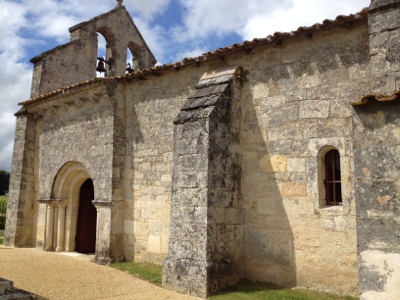
We are staying this week in a small village that cozies up to the banks of the Dordogne river in the Bordeaux wine growing region. Asques, like small and large cities throughout France, is enjoying a national summer concert series — the12th year for this series. Last night and this evening, we decided to attend two local concerts to listen to the classical music programs being offered. Asques is a small village and has an old roman church at the top of a small hill that overlooks the village and the Dordogne river. Last night’s concert was held inside. The inside of this church is very simple consisting of two elongated barrel vaults sitting side by side about 50 feet in length each. The adjoining vaults are supported by two simple Roman arches. The interior walls are barren except for the statues of Mary and Christ, and a small stained glass window here and there.
The concert presentation that evening was Opus 100 by Franz Schubert. The instrumentation consisted of piano, violin and cello.

Having played concert bass in school orchestras from junior high and into college, I am familiar with many of the classical composers and I wanted Cheryl to have the experience of attending something that the local people would themselves attend. As it turned out, we were the only non-locals there.

The musicians were set up in the middle of the church and seating was available in a half circle around them. The setting couldn’t have been more intimate. Surrounded by the village locals, we settled in. When the musicians started playing, we were startled to hear rich, vibrant tones coming from their instruments. At first, I thought they surely must be miked. Surprisingly, they weren’t. The acoustics of this small chapel were amazing! You could hear every nuance that the exceptionally talented musicians played. It was incredible and a joy to listen to.

This evening we attended the other concert, Beethoven. The concert location was in the village of Mouillac, a short drive from Asques. As before, the concert was held in a small Roman church. This church, however, was about half the size of the previous one and was much more an example of ancient Roman architecture. At first, I was wondering how the musicians (a septet of violin, viola, cello, concert bass, French horn, bassoon, and clarinet) plus any audience could possibly fit into such a small space. The interior of this chapel was very simple, almost stark with few adornments of any kind, no windows, and the entire structure was a single barrel vault. The seven musicians sat at one end while the audience was, once again, seated in a semi-circle around them. The musicians were highly skilled professionals. Most were in their early thirties although we suspected that one or two were younger. Listening to the stringed instruments in such close proximity and with the acoustics of the chapel, made you appreciate the quality of the sound, the expressive inflection of every tone, and the crisp richness of every note. It was a wonderful experience and one that we will carry with us for a long time.

One of the things that we noticed and remarked to each about was the fact that in both concerts there were children. Not many but those who were present were about 3 and 4 years old. Not once during the two hour concert, including pauses lasting up to a minute between musical passages, did any of these children, talk, fidget, or make ANY disturbance of any kind! We were amazed! They simply sat next to their parents, quietly played with a toy, and slept if they felt like it. The adults (including yours trulies), showed the utmost respect for the musicians. Not a sound was heard from the audience to detract from the exceptional quality of the musicianship. The audience also held their very appreciative applause until the end of the presentation.

20120709-121827.jpg

The wonderful thing about traveling is when you discover traditions, customs, or behaviors in the local culture that are different from yours. Cheryl noticed that when the audience applauded, at first it sounded just like any other applause. But after a minute or two, there came a rhythm to it in the form of 3’s with a short pause between the next three. The musicians would exit and return to acknowledge the applause three times. This happened at both concerts.

The summer concert series for this area is over until later in the summer. We hope to catch other concerts series at our next location.

Ritzy Biarritz

20120708-135305.jpg

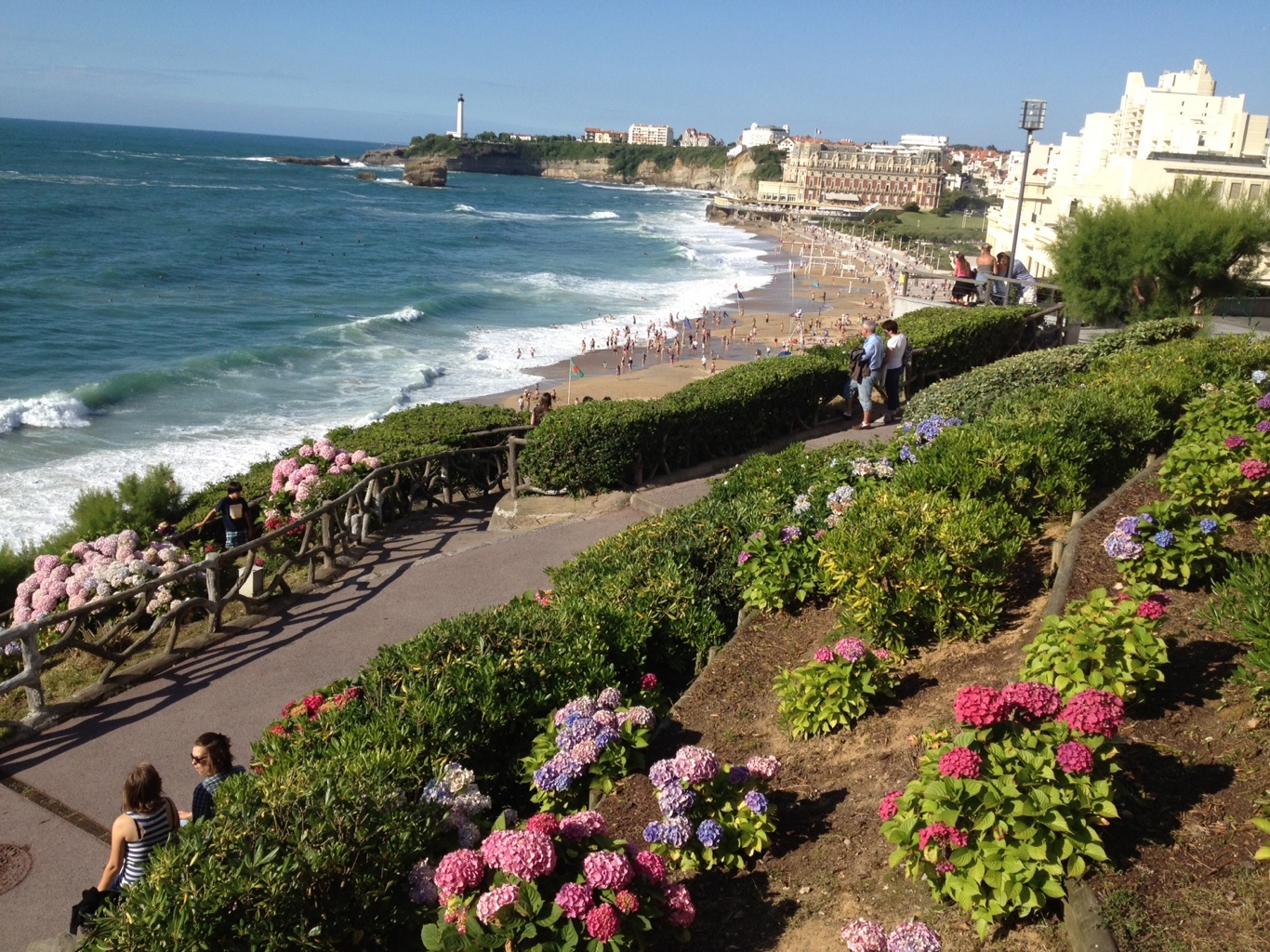
Biarritz — by my definition AKA:

  • Mini Montecarlo
  • Palm Springs with a Beach
  • Money, Money, Money ( you need it to be there or you can try to win it at the casino)
  • Lifestyles of the Rich and Famous (remember that show?)

(Wikipedia) …a Basque city which lies on the Bay of Biscay on the Atlantic coast in south-western France. It is a luxurious seaside town and is popular with tourists and surfers.

This was a one-night stopover in our transition back into France on the way to Bordeaux. Unfortunately, nothing remarkable for us as we felt we had been to many touristy places like this, but we had a great “hotel picnic” and a good night’s rest before moving on.

Wow! Bilbao!!

20120708-131842.jpg

Over the years I have heard much about the Guggenheim Museum in Bilbao so when we decided to include the Basque country in our travels, I knew we had to go there. For the average person, going to an art museum can be intimidating. However, when you are married to an artist, visiting art museums becomes a unique experience because you have at your fingertips a more educated perspective than the typical viewer would normally have at his/her disposal. It is wonderful to have someone who can explain the process of creating a particular piece of art or its relationship to a certain genre. It’s like having your own personal museum curator by your side. What I really appreciate about my husband’s perspective on art is that it’s very practical and down to earth. He has taught me that the art world is made up of a very small elite group of curators, directors, historians, and critics and they are the ones who decide what gets displayed and why… AND, that it’s not necessary to like the work they have chosen to hang in a particular gallery. It’s up to the individual to decide what he/she likes. You’re not required or obligated to be impressed by what these people have selected as examples of “great art”. This came as a great relief to me and I began enjoying our forays to various museums in California and then later beyond our borders to New York, Chicago, Washington D.C., Boston and, more recently, to France. So it was with the Guggenheim in Bilbao.

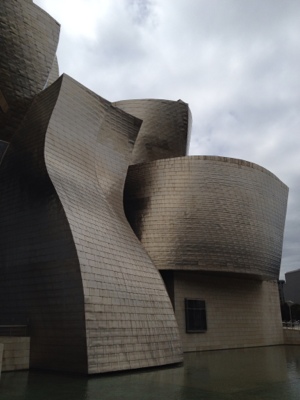
When we first arrived at the museum, we took in the various aspects of its architecture. The building is constructed of titanium, limestone, and glass. Its design is reflective of its location on a river in a port intended to look like a ship floating on water with 20 different galleries, the largest of which is shaped like a fish. Canadian architect Frank Gehry claims to have been inspired by his early experiences shopping for fish in the market with his grandmother and the nautical theme is fitting for Bilbao, a significant port on the Bay of Biscay in Spain. There are several sculptures installed around the outside of the museum creating an outdoor gallery space open to the public 24/7. Among these are the menacing araña (spider) titled Mother, the charming floral Puppy, the multicolored tulip bouquet, and the silver bubbles rising out of the surrounding pond. All of these artistic elements add interest to the structure and draw the visitor in. For me, these were especially enchanting.

Admission to the Guggenheim includes an audio guide initially intended to orient you to the museum — its architecture, layout, and purpose. Before you can even begin to wander the galleries and observe the work, you are bombarded with a battery of words and explanations. While this is all well and good, eventually you tire of this and just want to get on with the experience of the seeing the artwork. As I mentioned before, viewing art is very personal and everyone will have his/her own point of view which is exactly how it should be. I am not a big fan of modern art which is the focus of this museum, but I try to be open-minded. We wandered the three floors of the museum, discussed what we saw, and came to fairly mutual conclusions — like everything else in our lives, we have similar tastes in art. Once again, it was refreshing to know it was OK if I didn’t like something. As we like to joke, “It’s not illegal last time I checked.” In the end, we each chose our favorites and appreciated the fact that we were able to take in one more of the world’s renown art museums.

After leaving the Guggenheim, it was time to take a stroll through the old part of Bilbao known as Casco Viejo. We took the metro to the central hub of the city, Moyua Square, consisting of a roundabout with a beautifully landscaped city park in the middle and several impressive multistory buildings both new and old circling the exterior. From there we walked directly into Casco Viejo and found the typical narrow cobblestone streets, shops, bars, and restaurants. We stopped in at one particularly inviting location called Rio-Oja (a clever play on words for the local Rioja wines) and had a couple of kazuelas (casseroles) — a different kind of appetizer than the traditional pinxtos as they were quite a bit more substantial and meant to be shared. We chose the ever popular hake (cod) in a rich tomato sauce and anchovies prepared with olives and peppers in vinegar and oil. Surprisingly, French anchovies are not the skinny, salty, briny type we eat in the U.S. They are much larger, meaty, and very flavorful especially when served this way and it has become one of our favorite dishes.

Later, we wandered slowly through the narrow pedestrian streets looking in the various shops and stores… sampling peach ice tea, checking out local products, and of course, looking at the latest fashions. After some time in France & Spain, I have come to the conclusion that unless you have an unlimited budget and can go for a shopping spree on the Champs Élysées, there aren’t many unique fashion finds to be had. Just like Americans, the average European citizen is looking for a good deal and economical choices so most of the affordable clothing and accessories come from China. French and Spanish made items are just as difficult to find as American made in the U.S. Nevertheless, it’s always fun to window shop!

We had parked our car for the day in the underground parking of the Zubairte mall (yes, a mall — always exciting for me!) near the Guggenheim. So we returned there for a short time before heading out to dinner. I am always on the lookout for a regular supermarket — not that easy to find and not always open when you need them. Since there was one in the mall, I decided to pick up some Spanish gourmet products I had read about and wanted to try. I came away with an interesting selection for our future meals and picnics — pâté de campaña (pork liver), chipirones en su tinta (squid in ink), sardinillas, bonito, and the best prize of all, black truffles that only cost 4,50€. Can’t wait to try them all out.

20120708-132009.jpg

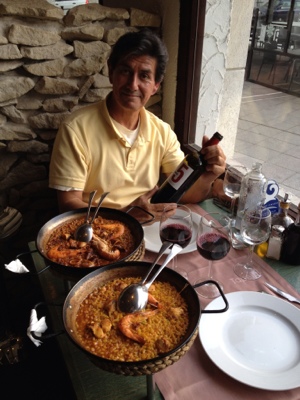
Finally, it was time to end our day with a special dinner of the one Spanish specialty we had not yet sampled — paella. It would be inexcusable to make a trip to Spain without having this dish at least once which, as you may know, has many, many versions. For this experience, we went to a small restaurant Laruzz Bilbao specializing in all types of rice dishes. After some contemplation, we made our choices which were served in individual paelleras. Accompanied by some bread and a bottle of excellent locally made red wine, it was the perfect finish to our day in Bilbao. Wow!!

Postcards from Bizkaia

20120704-224224.jpg

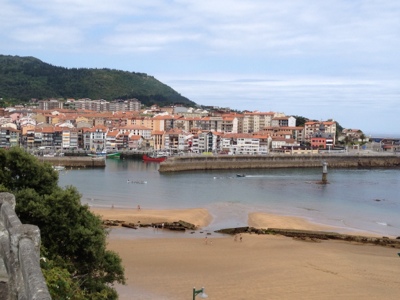
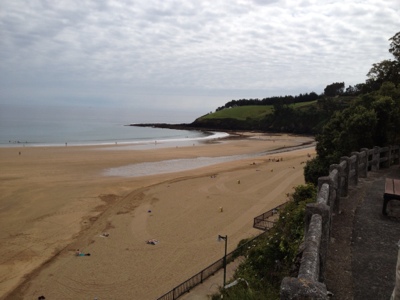
Today we ventured on amazing journey. After enjoying a wonderful breakfast in an glass enclosed atrium at our seaside hotel, we followed the narrow winding costal road and took in incredible views of this rugged and wild coastline. Thick, rich forest lined our route and a continuous carpet of ferns paved our way. Suddenly, and quite unexpectedly, we would come into a clearing that showed us glimpses of the many coves and inlets that are so much a part of this beautiful coastline. Then at the next turn, we came upon small villages tightly tucked into the crags formed by eons of time and shaped by the strength and force of nature.

Space along the coast is at a premium, so in the few villages that have established a foothold here, housing towers spawn up like vertical tentacles reaching for the sky. Everyone makes accommodations for the fact that life that clings to the crags must share very available inch of space. In Elantxobe for example, the main street narrows so much that the public bus cannot turn around at the end of the street to make the return trip back to San Sebastian. Adaptation and ingenuity are characteristic of the Basque and so the townspeople installed a turntable that allows the bus to rotate 180° so that it can return from where it came!

It is difficult to find the words to express the beauty of this Basque region. Mountainous, rugged, heavily forested with hidden coves as rugged as those of Big Sur, one’s eyes and senses can be overwhelmed. Looking out at the vast expanse of the Atlantic, you can actually see the slight curvature of the earth. And when traveling along the narrow twisting mountain road and coming upon a small village at the foot of vertical cliffs, you realize the beauty of the jewel you just chanced upon.

20120704-224424.jpg

We continued for several hours, stopping here and there to take in another breath of the beauty that surrounds us. And alas, we arrived in Guernica. Guernica is the phoenix of this region. Having suffered total devastation by Hilter’s bombers with the indulgence of Franco in 1937, Guernica was razed to the ground. Thousands of its townspeople perished. But true to the strong spirit of the Basque, the town was rebuilt, traditions restored, and today Guernica is a symbol of peace, tolerance, and forgiveness.
It is a lovely town, quiet, peaceful, where the pace of life is taken one step at a time.

Our intent today was to discover what the Basque have known all along about their region — that if there is a heaven, then you couldn’t get closer to it than this.

The Pyrenees & the Basque Country

20120704-211355.jpg

The natural border between France and Spain are the Pyrenees. A chain of beautiful snow-capped mountain peaks that reminds one of the Sawtooth Mountains of Idaho or the dramatic spires of the Grand Tetons in Wyoming. Spread across the landscape are small hamlets, chateaus, and farms. Beautiful trees of all kinds describe the changing geography. On the French side, the terrain is wider with gentle rolling hills and shallow valleys. Church spires and small castle towers dot the landscape here and there. Acres of lush deep green fields with rows of what look similar to corn fill in the the spaces. Everything is embraced by trees.

As we head west into Spain’s northern Basque region, the landscape becomes more dramatic. Skirting the northwest end of the Pyrenees, we follow steeper hills and narrow valleys. Tunnels direct us through mountains that spill into the Atlantic and as we emerge on the other side, we are greeted with expansive ocean views. Here and there, we pass by exposed vineyards clinging to hillsides. The road twists and turns as we approach our first stop –San Sebastian.

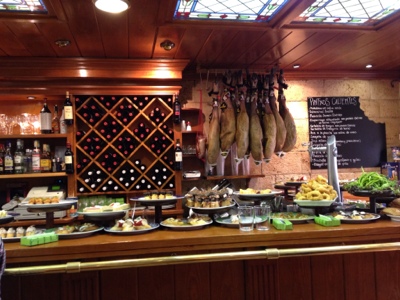
As one might imagine, planning a vacation of this length requires serious research into lodging, transportation, eating, and sight seeing. I feel very lucky that driving (while it can be and is stressful at times) is mostly my responsibility. Cheryl is the ultimate organizer and tourist information agent. She is ALWAYS checking, double checking our destinations as well as finding out all about the places we are about to visit. When eating out in France, the custom is similar to eating out back home, be it restaurant or cafe. Spain has quite a different tradition. In Northern Spain, pinxtos are similar to the tapas offered in bars and cafes in the southern part of the country. The Basque spelling uses “xt” in place of the Spanish “ch” in many words such as pinxtos (peen-chos). A great variety of these “hors d’oeuvres” line the counters of bars and cafes. Many bars have special pinxtos (the specialty of the house) that define that cafe/bar’s offerings. Upon entering a cafe, just ask for a plate, select what you want to try, and enjoy it with a beer (usually only one kind in smaller bars and cafes) or a local wine or cider. The idea is to have one or two pinxtos at one bar, then move on to another bar to try another one or two and so on. This is exactly what we did in San Sebastian. It was a great experience not just for the great variety of pinxtos, but to get into the mix of the local culture — listening to the banter of locals exaggerating stories or poking fun at each other. As one would expect, Basque (actually called Euskara) is the primary language here, and when you hear it spoken, there is no other language to which you can equate it. Luckily, Spanish is the primary language in everyday business establishments but you can also hear French, Italian, German, English sprinkled here and there.

San Sebastian is a port city of moderate size nestled in a beautiful cove caressed by the blue green ocean. The city center with its narrow roads and pedestrian-only sections lends itself to strolling along as you discover small shops, cafes, bakeries, bars and restaurants. On the inland side of the cove, sun bathers linger on the quarter mile long sandy beach backed by multistoried housing where it appears that every unit has a personal view of the ocean. It is a very beautiful city. We were very much impressed by it and look forward to a second visit on the way back into France.

Heading west along the coast we continue on to our destination. The Hotel Arbe overlooking the vast Atlantic from the cliff above a small cove.

20120704-211523.jpg

So Toulouse

20120703-001831.jpg

Traveling from Provence across southern France to Spain, we needed an interesting stopover that might provide a still different perspective of French life. We chose a short stay of three days in Toulouse, France’s 4th largest city and the capital of its aeronautics industry. It’s nickname is the “Pink City” due to the fact that much of the brick architecture is a peachy color which looks pink in the sunlight especially at sunset. University students make up a quarter of Toulouse’s population creating a lively, young atmosphere — quite a contrast to and a refreshing change from Provence which is filled with retirees.

On our last night in Le Paradou, we had planned to go out to a specially recommended restaurant, but when we researched it more, we discovered it was a popular hangout for the rich and famous. In fact, the French singer, Charles Aznavour, frequently dines there. Because of all the publicity, we felt it might be a bit overrated and we really wanted to avoid that scene so we decided to wait until we got to Toulouse. On our first evening here, we ventured out to Place du Capitole, a square in the city’s center, and witnessed for ourselves the peachy-pink colors cast at sunset on the grand city hall building known as Le Capitole. In this square there are a multitude of brasseries, one of which had come to my attention — Le Bibent, developed by well-known chef, Christian Constant who hails from the an area in southern France near Toulouse. It was obviously a very popular place, but we were lucky to find an available table on the patio overlooking the square. With a menu of regional offerings created from local products, we were able to enjoy some delectable dishes. Ironically, about half way through our meal, a little old man looking strangely familiar exited the restaurant and immediately attracted a crowd. It was none other than Charles Aznavour — in town to help host Le Marathon de Mots (the Marathon of Words), a celebration of authors, poets, and novelists. So it seemed we could not dodge the rich and famous after all.

Yesterday we made a short trip back to the city center via metro to visit the Fondation Bemberg. This magnificent building constructed for a wealthy merchant around 1555 houses the collection of Georges Bemberg who donated over 300 works of art from many periods of history including a large number of paintings by Pierre Bonnard. It is a small venue which makes viewing the artwork a very intimate experience. Afterwards, we discovered a very affordable menu du jour on the museum’s small covered terrace. This sort of offering generally consists of a salad or appetizer + a main dish or a main dish + dessert and sometimes a drink for one price. It is always the best and most economical way to eat your main midday meal if you can find it when you are hungry — a challenge for Americans as our stomachs run on different clocks than the French. It is served between noon and 2:00 or as late as 4:00 in some cases. Fortunately, we caught this one just in time.

20120703-001938.jpg

Our last stop for the day was the Basilique Saint Sernin. We were mostly interested in seeing this church because it is reputed to be the largest, finest, and purest Romanesque church in Europe. It was built in the 5th century to honor St. Saturnin, the first bishop of Toulouse who became a martyr in 250 after being dragged though the streets by a sacrificial bull. Ouch! It is also a major part of the pilgrimage to Santiago de Compostela. Sitting inside and admiring the massive, towering arches, it is very difficult to imagine the construction of such an immense structure in those early times. Truly impressive.

Today we finished off our stay in the pink city with a visit to Airbus City just outside Toulouse. Our tour focused on the construction of the Airbus A380, a double-decker jetliner which holds the title of world’s largest passenger plane. It debuted in 2007 a joint-venture between France, Spain, Germany, and the UK. We had the opportunity to learn how the prototypes were tested and see some of the plant facilities as well as view several planes on the tarmac just about ready for delivery — 3 of which were designated for Emirates Airlines toward their total order of 90 — one for each sheik I suppose. They only cost $389 million dollars each! Depending on the configuration, they hold anywhere from 525-853 people. Each plane weighs over 550 tons fully loaded. At that weight it’s hard to believe they can stay in the air. At the end of our tour, we were allowed to sit in a section of the body of an original prototype, but we were disappointed that we didn’t get to take a test flight. Top security on this tour — no photos allowed.

Tomorrow we are headed off to Spain to explore the Basque Country with a stopover for lunch in San Sebastian. We look forward to sharing again with you soon.

Post Navigation