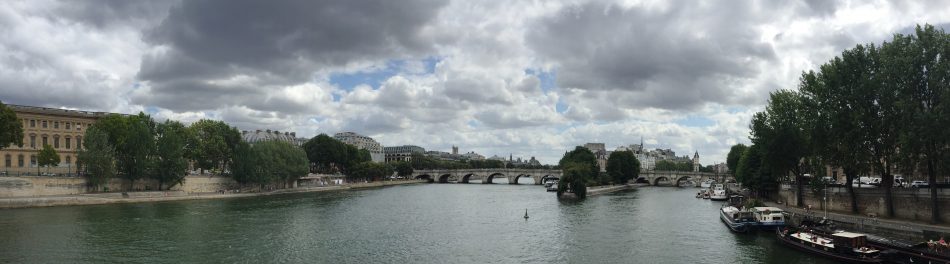
Paris and Beyond

Our Personal Tour de France & Other Exciting Adventures!

Spires to Heaven

20120620-212129.jpg

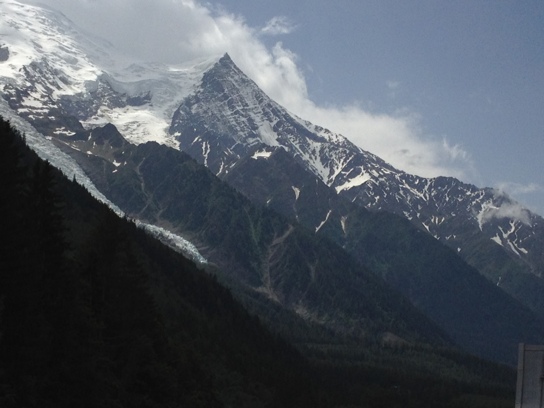
This morning, after having a sumptuous French “petit dejeuner” of fresh orange juice, fresh home baked five grain bread, homemade quince jam and yogurt with cereal, we departed for the Alps and to the valley village of Chamonix.

Chamonix is the premier winter and summer recreation area of Europe. The “village”, like any popular tourist area, has grown over time and now over 8,000 inhabitants call this home. Situated at the base of 15,771 foot Mont Blanc, it is the quintessential picture of a charming alpine village.

Before leaving Talloires this morning for Chamonix, it was raining heavily. We decided to go forward with our plans despite the weather. While we were hoping that the weather would be bright, sunny, and warm, we believe that when traveling anywhere, you need to adapt to every situation with the goal of enjoying your experience no matter what. After all, there are things that are totally out of your control.

Taking the scenic route (south), we meandered through some of the most beautiful mountain settings to be had. Little villages clustered along our route added country charm to the towering mountains as we made our way. After an initial detour that took us through some remote areas, our approach to Chamonix became sunnier. And upon our arrival, we were greeted with a great view of Mont Blanc, the surrounding Alps, and a warm sunny day.

Mother Nature doesn’t always cooperate and go along with your plans and as it turned out, while it was sunny, warm and bright in the valley, the top of the Aiguille du Midi (at 12,601′ where we planned to take the gondola up to) was too cloudy to see anything. So we opted to stay in the village and wander about. We stopped in at La Taverne de Chamouny, a German-style restaurant with a large outdoor terrace situated in the middle of a pedestrian plaza, and enjoyed German sausage with scalloped potatoes and German beer.

The wonderful thing about eating out at a restaurant or café, simply having something to drink be it a glass of wine, beer, or cup of coffee, is that once you sit down, the table is yours for as long as you wish. No one comes around with expectations that you will have to leave soon so that they can turn over the table to another customer. You can stay as long as you like, relax, and enjoy yourself. We have found this out at every cafe or restaurant we have enjoyed and today we spent three hours just hanging out, people watching, and admiring those amazing spires to heaven that lead to the Alps’ highest mountain…. Mont Blanc.
Medieval Times

20120620-210936.jpg

If you’ve ever wanted to have a real medieval experience, the countryside of Burgundy is the place to do it. On a quiet Sunday morning (most everything is closed as Burgundians enjoy a true day of rest), we left our hotel in Beaune to follow the Burgundy Canal north to the Abbey of Fontenay. Along the way, there are many sites to be seen not the least of which is the beautiful pastoral countryside populated here and there with the most intriguing white cows that are much prettier and less smelly than American ones. Even the cows are more sophisticated in France.

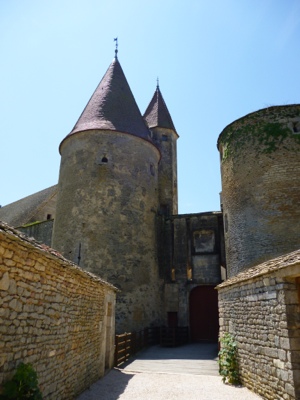
Our first stop was Châteauneuf-en-Auxois, a medieval castle that monitored travel between Burgundy and Paris from its 2,000 foot hilltop setting. The view of the Burgundy canal and the valley from the top are your first indication that you have traveled back in time. As you walk through the tiny village, you are in awe of the quaintness of authentic medieval architecture evident in every house and building. At this time of year, flowers of all kinds are in full bloom pouring out of window boxes and surrounding the old stone structures. Having taught 7th graders about the Middle Ages for several years, it was fascinating to see first-hand some of the true origins of this period of history.

Next stop, Semur-en-Auxois, a sleepy little medieval town with a couple of notable sights. Semur boasts 18 original medieval towers that were once connected by defensive ramparts to protect the city center from invaders. The town’s main sight is a church, of course — the Church of Notre-Dame, with some original stained glass windows from the 13th century as well as a set of windows honoring Semur’s WW I soldiers. Apparently there were many men from this entire region who lost their lives in the Great War. As you climb a hill on the way out of town, you are rewarded with a magnificent view of the whole town making you feel as if you are looking at a Disney recreation of a medieval village but knowing that the people below who live there are real and not imaginary characters.

20120620-211301.jpg

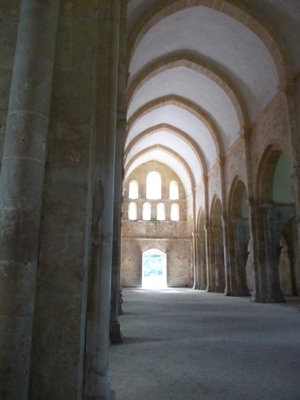
The jewel of the trip is your arrival at the Abbey of Fontenay, one of the oldest Cistercian abbeys in France, founded by St. Bernard in 1118. The purpose of the Cistercian movement was to reestablish the simplicity, solitude, and poverty of the early church. While it is a lush, peaceful, and inviting environment today, it is shocking to imagine what life was really like for those early monks for whom it is said St. Bernard created a “horrible vast solitude” among the marshy bogs (meaning of Cistercian) of Burgundy. Nevertheless, the movement spread essentially colonizing Europe religiously and lasting for almost 700 years. Since the monks had to be self-sufficient, it was necessary for them to develop talents in many areas one of which was the forging of tools such as the hydraulic hammer. Indeed, many consider Fontenay to be one of Europe’s first metalworking plants. They also grew a variety of herbs for medicinal purposes and raised huge trout to serve the nobility though, by their vow of poverty, they were never able to partake of any of it themselves.

Just outside of Fontenay we came across a small picnic area by the side of the road and stopped to have our lunch. Once rested and nourished, we were ready for our return journey. We followed a slightly different but equally beautiful winding country road all the way back to Beaune. It was such a satisfying trip because it was one of those rare experiences where the sights along the route were as appealing as the destinations.

From Rain to Shine

20120619-194505.jpg

Often when you plan to do things in your travels, it’s more complicated than you think it will be and takes a lot longer than you expect but it’s usually worth it. On the last day in Paris, we needed to go to the airport to pick up the car we were leasing for the 5 weeks of our trip we would be driving throughout France. Since we did not want to drag our luggage through the streets of Paris again, we thought it would be more convenient to leave it in the apartment and get it on our way back with the car. The airport is north of Paris and we were heading south so passing back through Paris was unavoidable anyway.

We set our alarm for 6 AM to make sure we got an early start. We had promised to be out of the apartment by noon and we figured this would give us plenty of time. We made breakfast so we could use up the last of our fresh groceries and be fortified for the journey. After doing the last of the cleaning, we set off to the Metro station at 8:15 connecting to the RER train for the 45 minute ride to the airport. Of course, it had to be the coldest and rainiest day of our entire week in Paris making travel a little slower and more difficult than usual. Eventually, we arrived at Charles de Gaulle Airport at 10:00 as planned. Next, we had to find a public phone (per instructions from the car leasing company), figure out how to use it, and call the company so they could pick us up in their shuttle. They told us to wait at departure Door 2. Being fairly unfamiliar with this gigantic airport, we made our best guess and chose Halle 2. After a few minutes, it dawned on us that this wasn’t the right place so we found our way to departures and went outside. Time passed and no shuttle appeared. Ah! Once again we realized we were still not in the right place. We were standing at Door 16! By the time we found door #2, it was 10:45. Norman went back inside to call the company — surely they had missed us. They instructed us to go to the nearest information desk, have the attendant call them, and wait for them there. FINALLY a young man showed up and escorted us to their shuttle.

Once at the car leasing agency, things progressed fairly smoothly in picking up the car. This type of leasing for Americans driving in Europe is a really good deal especially if you are staying three or more weeks. You can’t even beat the cost of the car with Eurail tickets which don’t really provide daily travel or access to out of the way places. We had arranged for a brand-new Peugeot Sedan. It’s very luxurious and comfortable and gets better mileage than most American cars. It has automatic everything you can think of plus GPS which was briefly explained to us before we took off — programmed by another young employee to get us back to the apartment. The car comes with very little fuel so we were handed a map with directions to the nearest gas station. Unfortunately, the gas station stop was not programmed into the route and the map was far from accurate so we missed the station completely. Before we knew it we were enmeshed in heavy midday traffic heading into the city with no gas station in sight. We were pretty sure our AAA coverage didn’t extend to Paris so we had to find gas somewhere. The signs at one exit seemed to indicate a gas station in the vicinity so we got off but just ended up going around in circles and ending up back on the freeway. We held our breath and hoped the gas would get us to the apartment.

We made it to the apartment but as we had anticipated, there was no place to park on the narrow one-way street. So Norman parked in front of the building’s garage exit door and hoped no one would be leaving home soon. He waited with the car while I made a few trips back and forth with the luggage. We got lucky, got the car loaded, and got out of there. Still no gas in the car though and it had already warned us twice that fuel was low. We had directions to the nearest gas station but it was still raining and driving in Paris under those conditions in a car you’ve never driven is no pique-nique! Alas, we passed it up — a little tiny storefront kind of gas place with one pump you would never recognize as a “gas station” — a little tiny turn in right off a busy, main street — and if someone is already there, you’re out of luck. After parking around the corner and figuring out how to get back to it, we were finally successful — fill’er up — €82 ($102), ouch!! Well, it was completely empty and it has a 60 liter (16 gal.) tank. So that’s about $6.37 per gallon. In a pinch in the middle of Paris that’s to be expected. At least we weren’t standing out in the rain waiting for a tow truck.

20120619-194126.jpg

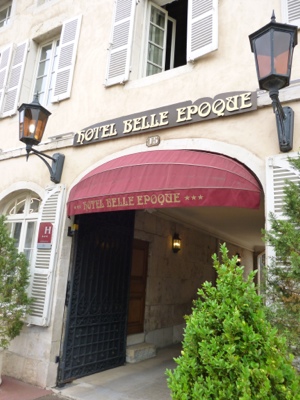
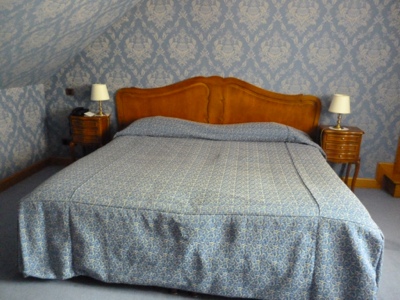
At last we were on our way to Beaune in the heart of Burgundy. As we drove south, the rain began to subside and the sun began to shine. What a welcome relief from the cool, wet weather of the past week! By now we were using the GPS more or less successfully and glad to have it. It speaks to you in a woman’s voice with a British accent — sort of like the one in James Bond’s cars. We’re trying to decide what to name her. Maybe one of our favorite Bond Girl names. Beaune is an old, fortified medieval town surrounded by a stone wall. You have to navigate the “ring” road which goes around it in only one direction. After many twists and turns through various roundabouts, our girl got us to our hotel, Belle Époque. It was 5 PM. The gentleman at the desk quickly showed us to our room explaining that they had to make some sort of change and give us a different room than we requested. This one he said was “a little big”. No kidding!! When he opened the door, we walked into our own little chateau — two stories with a spiral staircase leading to three bedrooms, a beautifully tiled large bath, and a walk-in closet. The walls were covered in a typically French patterned blue brocade and the slanted roof on the second floor was hung with miniature chandeliers. We were speechless! A shining end to our long, exhausting day… at Chateau Bleu.

20120619-194619.jpg

The Fruit of the Vine

20120619-000905.jpg

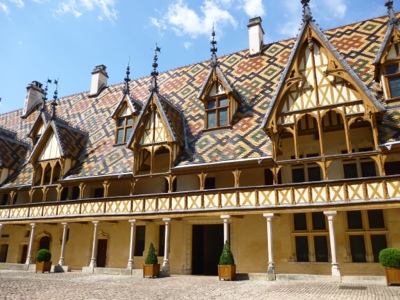
Today we started our journey in Beaune by visiting the Hôtel Dieu (a charity hospital for the poor) built by the wealthy chancellor of Burgundy, Nicolas Rolin, near the end of his life as a gift to the citizens of Beaune. During the Dark Ages, the plague devastated the population and 3/4 of its citizens were impoverished. For the poor, the Hôtel Dieu, was a place to go to die, free of charge. For the wealthy, in a separate section of the hospital, one could receive better care and higher odds of surviving “The Black Death”. For over 500 years, the hospital became established as one of the most important centers in the region for the treatment of the ill and did so until 1971. The Hôtel Dieu was a remarkable place and served its purpose well.

Being a charity hospital, funds had to be raised to pay for the day-to-day operations somehow. Beaune is renowned for being in the middle of one of the most prolific wine producing areas in France. And so, the idea to hold an auction once a year to raise funds for the hospital by auctioning off certain quantities of wines that are produced locally came naturally. This idea favored everyone. Wines producers, buyers, and the hospital all benefited from this event. The auction still occurs every November.

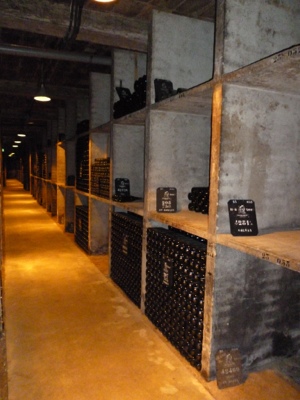
The region’s largest producer of wine is Patriarche Père et Fils which has the largest wine cellar in Burgundy. The cellar has more than 5 kilometers (3.10 miles!) of underground caves that run throughout the city and today stores more than 3,000,000 (yes, 3 Million!) bottles of wine.

One of the most pleasurable and interesting aspects of wine tasting at Patriarche Père et Fils is that you receive a Tastevins, a shallow saucer with a thumb handle, that you take around with you to taste the wines. The tour is self-guided and takes you directly down into the caves where you are astounded by the vast number of chambers most of which are filled with hundreds and hundreds of bottles of wine. Cool, dark, and musty, the caves provide the perfect temperature for the dusty, aging bottles that are stacked on simple notched strips of wood. There are no barriers, locks, or impediments of any sort other than lack of lighting in a chamber where one might be discouraged to enter.

You can wander about, explore each chamber, search for a particular wine, year or region. No one comes to rush you to the tasting room and out the door. While there are ” tasting rooms” similar to what one can experience in the U.S., our tasting room(s) consisted of an inverted barrel on which a single lit candle rested next to a bottle of the wine to be tasted. These barrels were situated in the very chambers where the wine being tasted was stored. There were five chamber “tasting rooms” with a total of 13 wines from whites to reds.

20120619-001022.jpg

Imagine casually strolling along these cool caves surrounded by immense quantities of wine both in barrels and bottles. Arriving at the tasting chamber barrels, you simply serve yourself from the open bottle. Taking as much time to taste each wine with no one to hurry you along or make you feel uncomfortably ignorant of your taste or lack thereof. We lingered at each bottle, relaxed and truly tasted each wine (sometimes more than once). And if a particular vintage didn’t suit our taste, we simply poured the sample into the bucket that was provided. It was made clear to us (by a young woman who explained the tasting procedure) that it was up to us to decide if we did or didn’t like a particular wine.

All in all, our wine tasting experience lasted several hours. And it has been one of the most pleasurable wine tasting experiences we have ever had. The most astounding thing was the trust, respect, and freedom that we were allowed to feel by being allowed to wander about the caves by ourselves; given the trust not to disturb or destroy a single bottle of wine. And most importantly, the respect we felt to enjoy our experience, by taking as much time as we wished without hurry, worry, or doubt.

Le Pique-Nique

20120617-232651.jpg

Before we left Paris, we wanted to make sure we had the necessary supplies for many impromptu pique-niques (yes, they really spell it that way) as we prepared to spend the next 5 weeks driving through France. When we were out shopping one day, I discovered the WalMart of France, a store called “Tati”. Even though it had been cold and rainy for some time, they had all their merchandise out for summer and it had been well picked over already. I guess the Parisians were anxious to get ready for their summer vacations which is understandable considering how long the winter seems to last. We easily found a small cooler and some freezer blocks. But finding plastic picnicware was a challenge. We managed to get the last two plastic cups, a package of small plates, and a couple of small knives. After searching in several other stores, we eventually acquired a small cutting board and napkins. At home we could have picked up these items in any one of a variety of stores very quickly and inexpensively.

This experience made me think about some differences in lifestyles between our two countries that one would only discover by spending more than a few days here and dealing with simple every day tasks. Where we are accustomed to having a wide choice of readily available paper and plastic products, the French seem to economize on these items. Typically, I would buy paper towels, napkins, tissue, and toilet paper for my household. Here all these paper goods are not necessarily available in every store. Paper towels and toilet paper, yes — napkins and tissue, not so much. And, anything made out of plastic is rare. Maybe they’re on the right track. They must certainly have less waste to dispose of than we do. Recycling is in place everywhere and you are expected to bring your own bag to most stores. We have just recently been required by law to do this in our city and I am just getting used to remembering my bags. I’m getting lots of practice in France.

The French value quality over quantity — a concept that used to exist in the US. Nowadays we are more concerned with the bottom line than customer satisfaction. French products are expensive and fuel prices are very high, but after some time here, you can’t help but think that you might actually be getting more for your money. Wines are excellent, even the cheapest ones. Roads are smooth and well-maintained, including those in the countryside.

20120617-232823.jpg

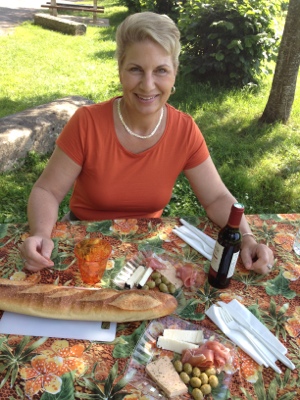
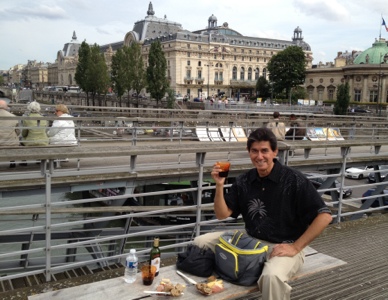
In the end, we assembled a very respectable picnic set that will serve us well throughout our journey. Indeed, we have already put it to use a couple of times. Prior to our visit to the Musée d’Orsay, we had a picnic dinner on a bridge over the Seine. Today we stopped at one of many small picnic spots in the heart of the Burgundy countryside after our drive through several small medieval villages and a visit to the Abbey of Fontenay. It’s a lovely way to enjoy the country and we are looking forward to many more pique-nique stops.

An interesting side note: There is no open container law in France. You can enjoy a bottle of wine with your picnic without having to hide it or fear being caught with it and asked to throw it out. The French police themselves by making it socially clear that it’s not cool to get loud or out of hand in public. You know, a little bit of common sense and respect for your fellow man. What a concept!

La Vie Parisienne… Parisian Life

20120615-224350.jpg

This week we have spent some time enjoying the typical attractions of the city of Paris. But, as planned, a lot of our time has been dedicated to figuring out how to live like the Parisians. From speaking French, understanding the Metro, handling Euros, shopping for every day items like groceries and sundries it has been a learning experience. While Norman has carried on in French fairly well for our basic needs, I have not quite conjured up the necessary courage to spit out a complete sentence though I understand much of what I read or hear. This has always been a problem for me in learning another language. I suspect that after 7 weeks of travel I will be able to do a little better.

Since we are staying in an apartment, we have had a chance to live more like Parisians than if we stayed in a hotel. We walked to the local stores to buy our provisions for the day with the obligatory stop at the boulangerie. We prepared our own meals. We did our laundry in the washing machine located in the kitchen and then hung everything to dry with a variety of adjustable hanging devices in the bathroom. And, since we depart tomorrow, today was cleaning day. All the same things you would do at home but with a few modifications.

Of course, we brought several electrical adapters for our iPhone, iPad and camera chargers as well as other small appliance like a blow dryer and iron. All of these things are capable of dual voltage so it is much easier to use them than in the past when you also had to have a converter. But learning how to use French appliances can be a challenge. Yesterday Norman spent an hour trying to figure out how to get the washing machine and microwave (both on the same circuit) to work before we could wash our clothes and heat milk for his coffee. After finding and inspecting the circuit breaker which seemed fine, it finally turned out that the hidden surge protector to which they were connected was switched off.

Our apartment is small — about 400 square feet (large by Paris standards) — so everything has been designed or set up for a compact life. There are surge protectors with multiple outlets everywhere you look in order to increase the number of things you can plug in at any given moment. One hopes you won’t blow a fuse. There is built-in storage in every available space. Furniture is small but comfortable including the bed which is nothing like the monster bed we have at home.

So the saying, “When in Rome, do as the Romans do,” holds true. Whether adjusting to the weather (it has been mostly overcast, cold, and rainy), shopping, going out to get something to eat, traveling around the city, or strolling through your neighborhood, the thing to remember is that no matter what you do, do it with the idea of enjoying yourself. Don’t be afraid to walk into a store, a boulangerie, a farmer’s market, a supermarché, a museum, a café, or any other place. If you just make a small effort to communicate in French remembering to say Bonjour when you enter and Merci, au revoir when you leave, you’ll always be met with a kind and pleasing response. During this entire week, we have not experienced a single negative or rude reply from anyone even when we could hardly communicate.

Musée du Louvre

20120615-003612.jpg

Paris is full of some of the best art museums in the world. You can literally OD on art here and there is definitely something for every taste. My personal favorites are the impressionists and there is no shortage of that — the Orsay, Marmottan, and Orangerie among others are all filled with their work. However, like every good student, it’s important to study the beginnings of anything be it language, music, or art. Hence, a trip to the famed Musée du Louvre.

Being married to an artist has several advantages when visiting art museums. First of all, you have a personal guide who can tell you all about different periods of art, explain various techniques, and answer lots of questions. You also have someone to remind you not to take things too seriously. After all, what ends up on the museum wall sometimes seems arbitrary. The value of art is very subjective. So really you need to decide for yourself what has value to you. You’re not obligated to like anything just because some curator said it was important. My approach is to look at the “required” popular pieces and then go find something — one piece I’d like for myself — the one I’d like to take home… no matter what anyone else thinks.

The Louvre as we know it now began in the 12th century as a fortress and dwelling for a succession of kings. Over time it was added to and enlarged upon. The transformation from palace to museum began in 1793 during the reign of Louis XVI and in 1882 the Louvre ceased to be the seat of power and was almost exclusively devoted to culture. Only the Finance Ministry maintained offices in the Richelieu Wing until 1981. In 1983, the extension and modernization of the Louvre was entrusted to Chinese-American architect I. M. Pei whose controversial glass pyramid was inaugurated in 1989. The Galeries du Carrousel (underground shopping mall and parking garage — with the addition of an Apple store in 2009) made their appearance in 1993. At present, nearly 35,000 objects from prehistory to the 19th century are exhibited over an area of 652,300 square feet.

20120615-003848.jpg

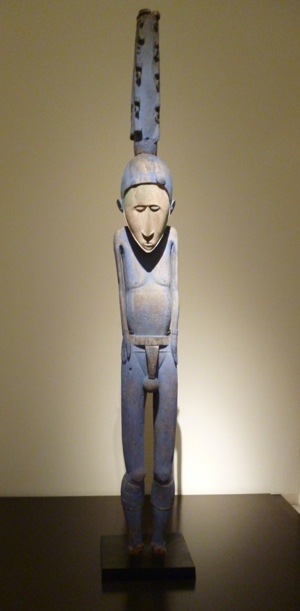
A visit to the Louvre can be overwhelming and exhausting if you’re not careful. Since it was my first experience, Norman let me lead the way and we managed to cover a lot of ground in about three hours. We began with the requisite viewing of da Vinci’s Mona Lisa (actually more impressive than I expected her to be), the Winged Victory of Samothrace (Greek goddess Nike – 190 BC), and Venus de Milo (Greek goddess Aphrodite 130-100 BC). Normally I’m not all that enthralled with ancient art, but the Greek and Roman sculptures are so impressive it’s difficult to ignore them. Then we meandered through all (yes, ALL) three wings. We had planned an evening visit with hours until 9:30PM so it was not crowded and there were plenty of comfortable places to sit and enjoy the art, architecture, and atmosphere of the museum. We unintentionally ended up in Napoleon III’s Apartments (carpet on the floor — aaahh!) — something I wouldn’t have chosen to see but am glad we didn’t miss. Did I find something I wanted to take home? Well, actually we both found favorites among the art of Africa and the Americas. Mine was a wooden sculpture I will call the “Blue Man” and Norman’s was a fetish (protective figure covered with nails) from the Congo that sort of looked like a porcupine. We made arrangements to ship them home.

The City of Light

20120614-134629.jpg

The first time I saw Paris was standing in the middle of the Pont des Arts where I could just see the top of the Eiffel Tower. I had dreamt of traveling to Paris for so long that I could hardly believe my eyes. If I was looking at the Eiffel Tower, I must really be in Paris. For some reason, it brought tears to my eyes which is something I rarely experience unless I’m watching some sappy chick flick. But this was no movie. It was the real thing!

So, for me, a return trip to the “City of Light” would not be complete without a visit to the Eiffel Tower. Paris was originally nicknamed the “City of Light” because it was a vast center of education and ideas during the Age of Enlightenment. In 1828, Paris began lighting the Champs-Elysées with gas lamps. It was the first city in Europe to do so, and so earned the nickname “La Ville-Lumière” or The City of Light.

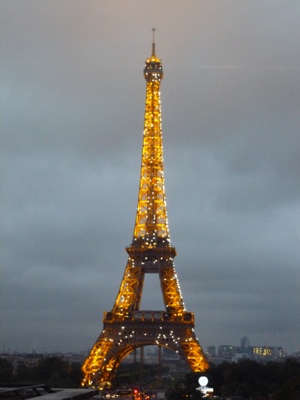
The Eiffel Tower was designed and built by Gustave Eiffel as an entrance to the 1889 World’s Fair to celebrate the 100th anniversary of the French Revolution. At a height of 1,050 feet, it held the title of world’s tallest building until 1930 when it was surpassed by the Chrysler Building. In 1957, the Eiffel Tower reclaimed its title with the addition of its antenna. While it has been the object of much criticism, it has become the most iconic symbol of Paris and the whole of France for that matter. Lighting of the tower began in 1985 with several projectors illuminating it from the inside. To celebrate the millennium, a beacon and sparkling lights were added. This spectacle of light can be seen at dark every evening on the hour for 5 minutes until 1AM. The best viewpoint is from the terrace of the Place du Trocadéro. Installing the lights was no easy feat. It was accomplished over a period of 5 months with the aide of 25 mountain climbers who attached 20,000 special light bulbs one at a time.

20120614-134746.jpg
Late one evening, we made our way to Trocadéro to view this iconic landmark in all its glory. We had previously traveled to the top so we did not feel the need to do this again especially since the tower is currently functioning with only one lift instead of two. It doesn’t get dark until very late so we had a bit of a wait on a breezy, cool night threatening to rain, but the Iron Lady did not disappoint. At 10PM we watched the 20,000 twinkling lights come on and sparkle like a fine diamond. Drawn by her charm, we overstayed our welcome and got caught in the impending rain. Our hasty retreat to the nearest Metro led to an unfortunate fall on a slippery, wet metal plate covering utilities beneath the sidewalk. Fortunately, I was wearing black and only my elbow was worse for the wear. I had paid my price for the visit, but it was well worth it.

La Cuisine

20120613-231041.jpg

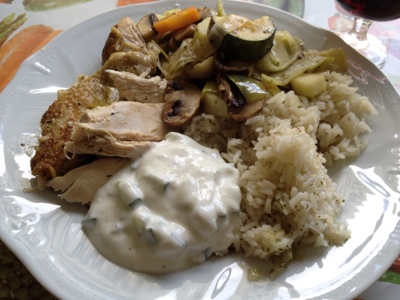
So far we’ve only eaten one meal out which is intentional. We purposely chose most of our accommodations to include a kitchen so we could cook. Eating out every day for 51 days would be impossible both physically and financially. And, since we both like to cook, it is fun to shop in a different environment. By now we have purchased a wide variety of French groceries and Norman has prepared many delicious meals for us. It is interesting to note that the quality of these products seems to be superior to what we have in the US. For example, yesterday we had chicken and potatoes prepared in a Dutch Oven seasoned with Herbs de Provence. The chicken was meaty but not fatty and flavorful throughout — even the breast meat was very tasty. There are several brands of fruit juices which are sold in tall, square cartons that contain at least 50% real fruit juice and they are delicious. We wanted a large container of plain yogurt and settled on the least expensive store brand of something called fromage blanc which turned out to be equivalent to Greek yogurt — very tasty by itself or served up with some fruit for breakfast or dessert.
20120613-231215.jpg

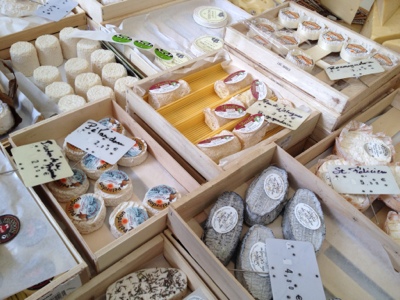
Of course, there are a few products for which France is especially renown like wine and cheese. As you might imagine, the selection of cheeses is overwhelmingly endless. Charles de Gaulle supposedly once asked, “How can you govern a country which has 246 varieties of cheese?” We have enjoyed a few kinds already and even the ones whose names we recognize seem much creamier and more flavorful than what we buy at home. Perhaps you might say that it’s just because we’re on vacation that everything tastes so good. In fact, the French go about the production of many of their foods in a manner that is no longer followed in the US where food production is driven by profit and quantity, not quality. The French still raise their animals on small farms where they can roam free and eat from the land. They call a pig a pig and a cow a cow — no special words for these when they come to the table like pork or beef. Cheese, like wine, is granted a certification that it comes from a particular region. This is the AOC label which stands for Appellation d’Origine Contrôlée and translates as “controlled designation of origin”. If you are a wine enthusiast, you are familiar with the concept of terroir which refers to the special characteristics that the geography, geology, and climate of a certain place bestow upon particular produce. The French apply this to many of their products including nuts, green lentils, and onions. Restricting a product to be made only in its region of origin limits production, but results in the quality that the French expect.

Why French Women Don’t Get Fat

20120612-111750.jpg

Mireille Guiliano had a runaway best seller with a book of this title. She gives all kinds of advice about how to live like a French woman, enjoy all the good things in life, and remain slim and beautiful. I decided that it’s really not all that complicated. If you walk and use the Metro to get around Paris, I’m convinced that’s all you need to do in order to stay perpetually slim and trim. You’re easily going to burn off anything you could possibly have the time to stop and eat. The fact of the matter is navigating a big city without a car whether New York or Paris involves endless walking.

This morning while I was getting ready, Norman walked to the boulangerie to buy a couple of baguettes for later in the day and two delicious apricot filled pastries for breakfast. He commented that the baker’s wife had a long face and when I asked him why, he said it’s because she’s stuck there. The ovens are in the basement of the building where her husband works from 10pm till 4am, the tiny store on street level is open seven days a week all day long, and they live in the apartment above. He’s probably right.

After breakfast, we walked to our local marché to buy some more groceries for our pantry. Then we set off to re-explore the area around the Louvre and Pont des Arts that was my first introduction to Paris six years ago. This involved a combination of walking and using the Metro which seemed like mostly walking. When you exit one Metro stop to transfer to another line, it often requires half a mile or so of walking through a maze of passageways to the connection. This generally includes flights of stairs both up and down — remember the trip with the luggage? It looks so direct and simple on the map, but it’s very misleading. It makes you think you should have just walked all the way to your destination in the first place. And if you’re not sure which exit to the street you should take (you usually pick the wrong one) you end up three blocks in the wrong direction before you realize you need to turn around. After a day of doing this, we figured even the Parisians must get confused from time to time.

I don’t envy the people with cars either. Unless you can drive like Tom Hanks in The Da Vinci Code, driving through the narrow streets is crazy and parking is impossible. We noticed that people park wherever they can even if it’s obviously illegal. The police are out in force giving parking tickets but they seem to just pile up on illegally parked cars. We observed some vehicles with huge collections that hadn’t been towed. In fact, we haven’t seen any tow trucks at all. For obvious reasons, there is a plethora of motorcycles and scooters all over the place and I do admire the women who are dressed to the nines with hose and heels riding them around the city.

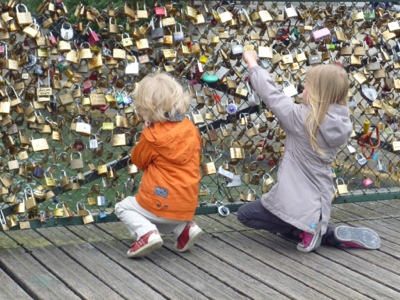
Eventually our Paris hike came to a temporary stop on Pont des Arts which crosses the Seine between the Louvre (originally named the Palais des Arts — hence the name of the bridge) and the Institut de France and has the distinction of being the first metal bridge in Paris thanks to Napolen. Due to its unique point of view, it serves as a plein air studio for many painters and photographers who are often present there. On this day we encountered one lone painter and were serenaded by a colorfully dressed gypsy woman playing an accordion. Pont des Arts is also well-known as a bridge for lovers. The chain link fencing on either side sports an overwhelming array of love padlocks, a tradition that can be seen in various places throughout Europe. The story goes that a couple writes their names on the lock, locks it onto the bridge, and throws the key into the Seine as symbol of their undying love. Of course, if things don’t work out, you have to come back with bolt cutters. There are two bridges where this phenomenon occurs — Pont des Arts is said to be for committed love and Pont de l’Archevêché is for lovers. The latter is reportedly packed with locks compared to the former which still has plenty of room for more. Humph!
20120612-112043.jpg
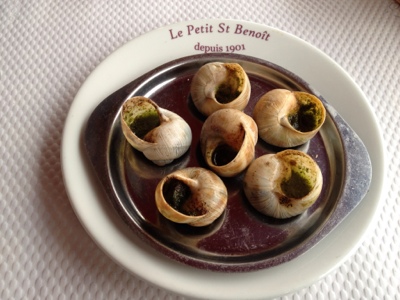
After all this exercise, I was getting hungry and in need of a bathroom. This meant we had to stop somewhere and eat anyway if we wanted to find a bathroom. We continued our walk over the bridge and into Saint Germain des Prés, a very upscale neighborhood and once the home of the existentialist movement — basically where the famous people that lived in our neighborhood of Montparnasse went to hang out for coffee and talk (think Sartre at Starbucks). It’s two most well-known cafes are Les Deux Magots and Café de Flore which you see in every travelogue and movie about Paris. We made a more obscure (and economical) choice, Le Petit St. Benoît, where we indulged in an appetizer of escargot. Someone pointed out that the only reason they taste so good is because of the rich sauces in which they are prepared which I think is probably true. We followed this with a fish cassoulet for Norman and a chanterelle risotto for me and, of course, some wine. No need to feel guilty about the carbs in my dish as I knew I still had the long walk back ahead of me.

When we finally arrived back at our apartment, we realized we had been gone for six hours! We rested, had a small meal while watching the season finale of Madmen on Norman’s iPad (yes, thanks to the Internet and wifi, you don’t have to worry about missing anything from home) and then… We went for an after-dinner walk!!

Post Navigation