Paris and Beyond

Our Personal Tour de France & Other Exciting Adventures!

Wow! Bilbao!!

20120708-131842.jpg

Over the years I have heard much about the Guggenheim Museum in Bilbao so when we decided to include the Basque country in our travels, I knew we had to go there. For the average person, going to an art museum can be intimidating. However, when you are married to an artist, visiting art museums becomes a unique experience because you have at your fingertips a more educated perspective than the typical viewer would normally have at his/her disposal. It is wonderful to have someone who can explain the process of creating a particular piece of art or its relationship to a certain genre. It’s like having your own personal museum curator by your side. What I really appreciate about my husband’s perspective on art is that it’s very practical and down to earth. He has taught me that the art world is made up of a very small elite group of curators, directors, historians, and critics and they are the ones who decide what gets displayed and why… AND, that it’s not necessary to like the work they have chosen to hang in a particular gallery. It’s up to the individual to decide what he/she likes. You’re not required or obligated to be impressed by what these people have selected as examples of “great art”. This came as a great relief to me and I began enjoying our forays to various museums in California and then later beyond our borders to New York, Chicago, Washington D.C., Boston and, more recently, to France. So it was with the Guggenheim in Bilbao.

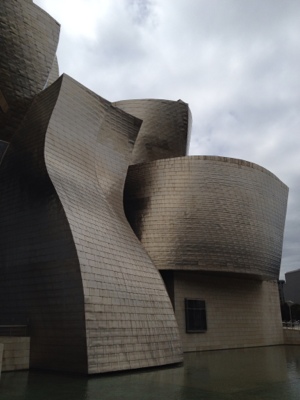
When we first arrived at the museum, we took in the various aspects of its architecture. The building is constructed of titanium, limestone, and glass. Its design is reflective of its location on a river in a port intended to look like a ship floating on water with 20 different galleries, the largest of which is shaped like a fish. Canadian architect Frank Gehry claims to have been inspired by his early experiences shopping for fish in the market with his grandmother and the nautical theme is fitting for Bilbao, a significant port on the Bay of Biscay in Spain. There are several sculptures installed around the outside of the museum creating an outdoor gallery space open to the public 24/7. Among these are the menacing araña (spider) titled Mother, the charming floral Puppy, the multicolored tulip bouquet, and the silver bubbles rising out of the surrounding pond. All of these artistic elements add interest to the structure and draw the visitor in. For me, these were especially enchanting.

Admission to the Guggenheim includes an audio guide initially intended to orient you to the museum — its architecture, layout, and purpose. Before you can even begin to wander the galleries and observe the work, you are bombarded with a battery of words and explanations. While this is all well and good, eventually you tire of this and just want to get on with the experience of the seeing the artwork. As I mentioned before, viewing art is very personal and everyone will have his/her own point of view which is exactly how it should be. I am not a big fan of modern art which is the focus of this museum, but I try to be open-minded. We wandered the three floors of the museum, discussed what we saw, and came to fairly mutual conclusions — like everything else in our lives, we have similar tastes in art. Once again, it was refreshing to know it was OK if I didn’t like something. As we like to joke, “It’s not illegal last time I checked.” In the end, we each chose our favorites and appreciated the fact that we were able to take in one more of the world’s renown art museums.

After leaving the Guggenheim, it was time to take a stroll through the old part of Bilbao known as Casco Viejo. We took the metro to the central hub of the city, Moyua Square, consisting of a roundabout with a beautifully landscaped city park in the middle and several impressive multistory buildings both new and old circling the exterior. From there we walked directly into Casco Viejo and found the typical narrow cobblestone streets, shops, bars, and restaurants. We stopped in at one particularly inviting location called Rio-Oja (a clever play on words for the local Rioja wines) and had a couple of kazuelas (casseroles) — a different kind of appetizer than the traditional pinxtos as they were quite a bit more substantial and meant to be shared. We chose the ever popular hake (cod) in a rich tomato sauce and anchovies prepared with olives and peppers in vinegar and oil. Surprisingly, French anchovies are not the skinny, salty, briny type we eat in the U.S. They are much larger, meaty, and very flavorful especially when served this way and it has become one of our favorite dishes.

Later, we wandered slowly through the narrow pedestrian streets looking in the various shops and stores… sampling peach ice tea, checking out local products, and of course, looking at the latest fashions. After some time in France & Spain, I have come to the conclusion that unless you have an unlimited budget and can go for a shopping spree on the Champs Élysées, there aren’t many unique fashion finds to be had. Just like Americans, the average European citizen is looking for a good deal and economical choices so most of the affordable clothing and accessories come from China. French and Spanish made items are just as difficult to find as American made in the U.S. Nevertheless, it’s always fun to window shop!

We had parked our car for the day in the underground parking of the Zubairte mall (yes, a mall — always exciting for me!) near the Guggenheim. So we returned there for a short time before heading out to dinner. I am always on the lookout for a regular supermarket — not that easy to find and not always open when you need them. Since there was one in the mall, I decided to pick up some Spanish gourmet products I had read about and wanted to try. I came away with an interesting selection for our future meals and picnics — pâté de campaña (pork liver), chipirones en su tinta (squid in ink), sardinillas, bonito, and the best prize of all, black truffles that only cost 4,50€. Can’t wait to try them all out.
20120708-132009.jpg

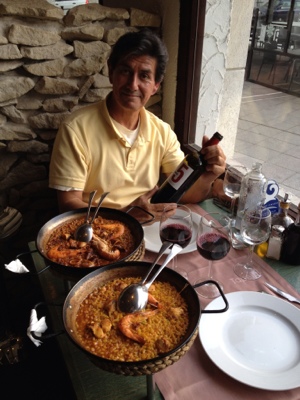
Finally, it was time to end our day with a special dinner of the one Spanish specialty we had not yet sampled — paella. It would be inexcusable to make a trip to Spain without having this dish at least once which, as you may know, has many, many versions. For this experience, we went to a small restaurant Laruzz Bilbao specializing in all types of rice dishes. After some contemplation, we made our choices which were served in individual paelleras. Accompanied by some bread and a bottle of excellent locally made red wine, it was the perfect finish to our day in Bilbao. Wow!!
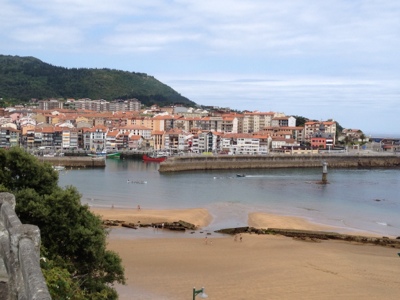
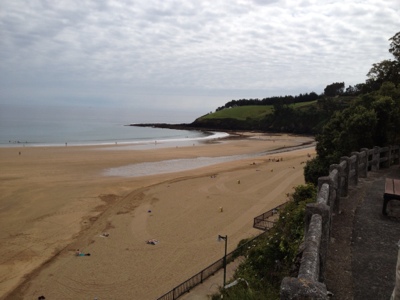
Postcards from Bizkaia

20120704-224224.jpg

Today we ventured on amazing journey. After enjoying a wonderful breakfast in an glass enclosed atrium at our seaside hotel, we followed the narrow winding costal road and took in incredible views of this rugged and wild coastline. Thick, rich forest lined our route and a continuous carpet of ferns paved our way. Suddenly, and quite unexpectedly, we would come into a clearing that showed us glimpses of the many coves and inlets that are so much a part of this beautiful coastline. Then at the next turn, we came upon small villages tightly tucked into the crags formed by eons of time and shaped by the strength and force of nature.

Space along the coast is at a premium, so in the few villages that have established a foothold here, housing towers spawn up like vertical tentacles reaching for the sky. Everyone makes accommodations for the fact that life that clings to the crags must share very available inch of space. In Elantxobe for example, the main street narrows so much that the public bus cannot turn around at the end of the street to make the return trip back to San Sebastian. Adaptation and ingenuity are characteristic of the Basque and so the townspeople installed a turntable that allows the bus to rotate 180° so that it can return from where it came!

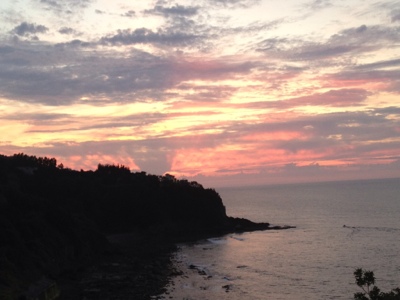
It is difficult to find the words to express the beauty of this Basque region. Mountainous, rugged, heavily forested with hidden coves as rugged as those of Big Sur, one’s eyes and senses can be overwhelmed. Looking out at the vast expanse of the Atlantic, you can actually see the slight curvature of the earth. And when traveling along the narrow twisting mountain road and coming upon a small village at the foot of vertical cliffs, you realize the beauty of the jewel you just chanced upon.

20120704-224424.jpg

We continued for several hours, stopping here and there to take in another breath of the beauty that surrounds us. And alas, we arrived in Guernica. Guernica is the phoenix of this region. Having suffered total devastation by Hilter’s bombers with the indulgence of Franco in 1937, Guernica was razed to the ground. Thousands of its townspeople perished. But true to the strong spirit of the Basque, the town was rebuilt, traditions restored, and today Guernica is a symbol of peace, tolerance, and forgiveness.
It is a lovely town, quiet, peaceful, where the pace of life is taken one step at a time.

Our intent today was to discover what the Basque have known all along about their region — that if there is a heaven, then you couldn’t get closer to it than this.

The Pyrenees & the Basque Country

20120704-211355.jpg

The natural border between France and Spain are the Pyrenees. A chain of beautiful snow-capped mountain peaks that reminds one of the Sawtooth Mountains of Idaho or the dramatic spires of the Grand Tetons in Wyoming. Spread across the landscape are small hamlets, chateaus, and farms. Beautiful trees of all kinds describe the changing geography. On the French side, the terrain is wider with gentle rolling hills and shallow valleys. Church spires and small castle towers dot the landscape here and there. Acres of lush deep green fields with rows of what look similar to corn fill in the the spaces. Everything is embraced by trees.

As we head west into Spain’s northern Basque region, the landscape becomes more dramatic. Skirting the northwest end of the Pyrenees, we follow steeper hills and narrow valleys. Tunnels direct us through mountains that spill into the Atlantic and as we emerge on the other side, we are greeted with expansive ocean views. Here and there, we pass by exposed vineyards clinging to hillsides. The road twists and turns as we approach our first stop –San Sebastian.

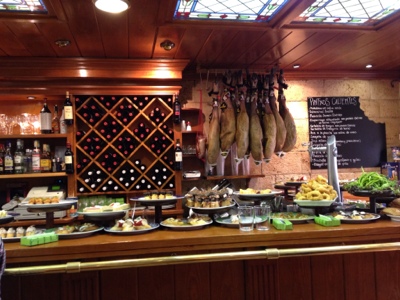
As one might imagine, planning a vacation of this length requires serious research into lodging, transportation, eating, and sight seeing. I feel very lucky that driving (while it can be and is stressful at times) is mostly my responsibility. Cheryl is the ultimate organizer and tourist information agent. She is ALWAYS checking, double checking our destinations as well as finding out all about the places we are about to visit. When eating out in France, the custom is similar to eating out back home, be it restaurant or cafe. Spain has quite a different tradition. In Northern Spain, pinxtos are similar to the tapas offered in bars and cafes in the southern part of the country. The Basque spelling uses “xt” in place of the Spanish “ch” in many words such as pinxtos (peen-chos). A great variety of these “hors d’oeuvres” line the counters of bars and cafes. Many bars have special pinxtos (the specialty of the house) that define that cafe/bar’s offerings. Upon entering a cafe, just ask for a plate, select what you want to try, and enjoy it with a beer (usually only one kind in smaller bars and cafes) or a local wine or cider. The idea is to have one or two pinxtos at one bar, then move on to another bar to try another one or two and so on. This is exactly what we did in San Sebastian. It was a great experience not just for the great variety of pinxtos, but to get into the mix of the local culture — listening to the banter of locals exaggerating stories or poking fun at each other. As one would expect, Basque (actually called Euskara) is the primary language here, and when you hear it spoken, there is no other language to which you can equate it. Luckily, Spanish is the primary language in everyday business establishments but you can also hear French, Italian, German, English sprinkled here and there.

San Sebastian is a port city of moderate size nestled in a beautiful cove caressed by the blue green ocean. The city center with its narrow roads and pedestrian-only sections lends itself to strolling along as you discover small shops, cafes, bakeries, bars and restaurants. On the inland side of the cove, sun bathers linger on the quarter mile long sandy beach backed by multistoried housing where it appears that every unit has a personal view of the ocean. It is a very beautiful city. We were very much impressed by it and look forward to a second visit on the way back into France.

Heading west along the coast we continue on to our destination. The Hotel Arbe overlooking the vast Atlantic from the cliff above a small cove.

20120704-211523.jpg

So Toulouse

20120703-001831.jpg

Traveling from Provence across southern France to Spain, we needed an interesting stopover that might provide a still different perspective of French life. We chose a short stay of three days in Toulouse, France’s 4th largest city and the capital of its aeronautics industry. It’s nickname is the “Pink City” due to the fact that much of the brick architecture is a peachy color which looks pink in the sunlight especially at sunset. University students make up a quarter of Toulouse’s population creating a lively, young atmosphere — quite a contrast to and a refreshing change from Provence which is filled with retirees.

On our last night in Le Paradou, we had planned to go out to a specially recommended restaurant, but when we researched it more, we discovered it was a popular hangout for the rich and famous. In fact, the French singer, Charles Aznavour, frequently dines there. Because of all the publicity, we felt it might be a bit overrated and we really wanted to avoid that scene so we decided to wait until we got to Toulouse. On our first evening here, we ventured out to Place du Capitole, a square in the city’s center, and witnessed for ourselves the peachy-pink colors cast at sunset on the grand city hall building known as Le Capitole. In this square there are a multitude of brasseries, one of which had come to my attention — Le Bibent, developed by well-known chef, Christian Constant who hails from the an area in southern France near Toulouse. It was obviously a very popular place, but we were lucky to find an available table on the patio overlooking the square. With a menu of regional offerings created from local products, we were able to enjoy some delectable dishes. Ironically, about half way through our meal, a little old man looking strangely familiar exited the restaurant and immediately attracted a crowd. It was none other than Charles Aznavour — in town to help host Le Marathon de Mots (the Marathon of Words), a celebration of authors, poets, and novelists. So it seemed we could not dodge the rich and famous after all.

Yesterday we made a short trip back to the city center via metro to visit the Fondation Bemberg. This magnificent building constructed for a wealthy merchant around 1555 houses the collection of Georges Bemberg who donated over 300 works of art from many periods of history including a large number of paintings by Pierre Bonnard. It is a small venue which makes viewing the artwork a very intimate experience. Afterwards, we discovered a very affordable menu du jour on the museum’s small covered terrace. This sort of offering generally consists of a salad or appetizer + a main dish or a main dish + dessert and sometimes a drink for one price. It is always the best and most economical way to eat your main midday meal if you can find it when you are hungry — a challenge for Americans as our stomachs run on different clocks than the French. It is served between noon and 2:00 or as late as 4:00 in some cases. Fortunately, we caught this one just in time.

20120703-001938.jpg

Our last stop for the day was the Basilique Saint Sernin. We were mostly interested in seeing this church because it is reputed to be the largest, finest, and purest Romanesque church in Europe. It was built in the 5th century to honor St. Saturnin, the first bishop of Toulouse who became a martyr in 250 after being dragged though the streets by a sacrificial bull. Ouch! It is also a major part of the pilgrimage to Santiago de Compostela. Sitting inside and admiring the massive, towering arches, it is very difficult to imagine the construction of such an immense structure in those early times. Truly impressive.

Today we finished off our stay in the pink city with a visit to Airbus City just outside Toulouse. Our tour focused on the construction of the Airbus A380, a double-decker jetliner which holds the title of world’s largest passenger plane. It debuted in 2007 a joint-venture between France, Spain, Germany, and the UK. We had the opportunity to learn how the prototypes were tested and see some of the plant facilities as well as view several planes on the tarmac just about ready for delivery — 3 of which were designated for Emirates Airlines toward their total order of 90 — one for each sheik I suppose. They only cost $389 million dollars each! Depending on the configuration, they hold anywhere from 525-853 people. Each plane weighs over 550 tons fully loaded. At that weight it’s hard to believe they can stay in the air. At the end of our tour, we were allowed to sit in a section of the body of an original prototype, but we were disappointed that we didn’t get to take a test flight. Top security on this tour — no photos allowed.

Tomorrow we are headed off to Spain to explore the Basque Country with a stopover for lunch in San Sebastian. We look forward to sharing again with you soon.

Provence: Le Mystique, le Soleil, le Provençal

20120629-223425.jpg

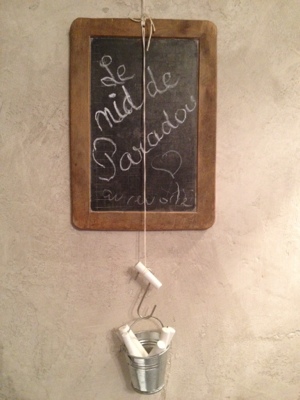
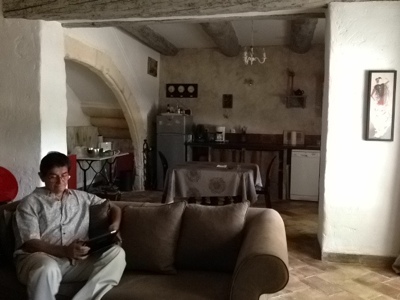
Well, we are about to wrap up our week in Provence. Our little “nid” (nest) provided us with the geographic center from which to explore the north, east, west and south of the Provençal region. We have seen castles, chateaus, fortified villages, and the Mediterranean Sea. This area of France is very different from the northern half of the country. It is dry, gets quite hot in the height of summer, has wide-open seemingly uninhibited spaces, flat terrain that can quickly change to hills, and is now occupied by many foreigners (mostly Brits) who come from colder, wetter climates.

Peter Mayle wrote A Year in Provence in the mid 80’s where he documented his experience moving from his native England and living in this area for a year. His insights into French culture still seem to hold true although time does not stand still and things do change. Some of the experiences we have had here has given us an opportunity to reflect on our own wants, needs, and expectations for ourselves. Part of the reason we wanted to come to Provence was because we had an ideal in our heads that maybe at sometime in the future, we might want to live here at least part of the year.

We both have lived in many places during our lives. From large metropolitan cites, to small isolated towns. In very cold climates where snow determined the pace of life to very hot, dry desert conditions where summer went on for nine months. Provence is a mecca for those that are retired (or are about to), who want to have dry, hot summer days where they can idle their time away sitting at a table in the plaza of a small country village.

20120629-223913.jpg

The greatest benefit of traveling is that being in another culture (especially when you are out of your own country) makes you reflect back on yourself. Cheryl and I are starting to appreciate even more the south bay area where we now live. Its moderate climate, wonderful afternoon sea breezes, easy access to a tremendous variety of venues, and the exciting mix of people make it for us, the ideal place to live. The mystic of Provence is not lost on us and we can understand the appeal for those that are drawn to this area. We, however, will leave Provence with a better understanding of ourselves and an appreciation for what Provence is and how it has helped us understand ourselves better.

The places we have been to have been amazing, intriguing, and historical. We would encourage anyone to visit Provence and experience for themselves the mystique and charm of the southern sun.

Make sure to check out our favorite images of Provence via the link at the top of the page.

A Day at the Beach

20120628-221619.jpg

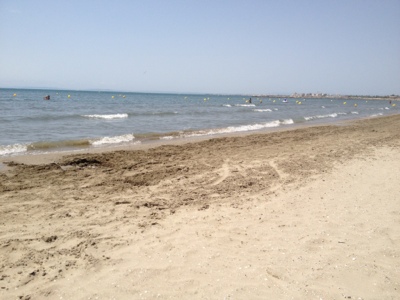
This morning we realized we had had enough of Roman ruins, ancient buildings, and cobblestone streets. We had considered going to Arles, but Van Gogh is not there and neither is any of his work. Feeling a bit too warm, dry, and claustrophobic in our little Paradou nest, we decided to head to the beach. After all, the Mediterranean is only an hour and a half away and since I had never been there, Norman wanted me to experience it. We packed up a picnic lunch and were off — guided as usual by our now trusty GPS companion, Moneypenny. Eventually, we arrived at our destination, a seaside town called Le Grau du Roi, a challenge for English-speakers to pronounce with those two French r’s — we’ve been working on it all day. You might compare it to Santa Cruz or Oceanside in California. We stopped in at the tourism office where a very informative young man gave us the scoop on the area — where to park, which were the best beaches, and the name of a hotel with a very good restaurant — plus a map to go with it which is very necessary. It’s not a large area, but everything is tightly squeezed in and it’s difficult to maneuver around town without some guidance.

We found our way to a beautiful beach with easy parking. The French vacation in the south of France during July and August so we haven’t encountered seasonal crowds yet. We set ourselves up on the beach near the water. Fortunately, we found a few items in our apartment to help us along with this such as beach chairs and a picnic basket. For a couple of hours we enjoyed relaxing on the beach and swimming in the Mediterranean — yes, swimming! I’m a California girl, but I grew up swimming in pools all my life. I’ve never been fond of swimming in bodies of water that have no edges and where I can’t see what’s on the bottom. About the only place I’ve ever swum freely in the ocean is Puerto Vallarta — something about having young children with me and the intense heat helped me overcome my fears there for the time being. Today, however, I was drawn to the inviting waters of the sea. The water was warm and shallow for several feet and the bottom was covered only with slightly rippled sand. There were no rocks, seaweed, or critters to impede wading calmly into the gentle surf. As I got out farther, the water became deeper, cooler, and more refreshing. It was truly delightful!

A variety of sunbathers and swimmers accompanied us for the afternoon — a grandfather playing water soccer with his grandson in the shallow waters, another set of grandparents introducing a toddler to the ocean possibly for the first time, and friends of all ages just hanging out together enjoying the day. Young men and women (some decidedly more enthusiastic than others) manned pushcarts along the beach selling glacé, beignets, and other tempting treats. People watching is always interesting at the beach, but after a couple of hours at a French beach, you understand why the Beach Boys wrote, “I wish they all could be California girls”.

As with every beach, thankfully, there is at least an ocean breeze or something a bit stronger — it’s what keeps you cool, right? In this case, it was a wind which began to pick up more and more taking the sand with it so we knew we would have to relocate for our picnic. We headed in the direction of the recommended hotel on the marina side of town and found a quiet park and completely unoccupied park, the perfect spot for lunch. We ate and relaxed surrounded by various building complexes which appeared to be vacation homes or rentals uniquely designed to looked like double-decker boats.

20120628-221801.jpg

After lunch, we walked out to the hotel past the marina filled with countless yachts large and small all shamefully not in use. Just like at home, people are typically out working to pay for them and rarely get to set sail. The marina is ringed by a number of hotels all in keeping with the theme designed to look like ocean liners — a bit unattractive really. Once we reached the hotel restaurant, we discovered it was closed… no explanation — it’s open in the evenings (but apparently 5 PM was not evening enough). There was also a grill restaurant by the pool which was inactive but seemed to have the potential to open at some point (though it never did). However, since no one was around, it turned out to be our personal oasis complete with comfortable outdoor furniture and palm trees where Norman was able to catch a nap and I started this post.

Rested and rejuvenated we still had one more wish on our list — an ice cold beer which we found back on the main drag at Quai des Artistes (how appropriate!) across from the beach — Belgian, delicious, and cheap! 5€ for two — the total amount of money we spent for the whole day.

Time to return home and enjoy the last day of our week in Provence before we head off to Toulouse in the Languedoc.

The Route to Anywhere

20120627-192550.jpg

One of the reasons we chose to travel throughout France in a car was because it is the best way to experience any location that you wish to visit. Driving is not for everybody, however, and there are many things you have to do to prepare in order to minimize any potential problems you might encounter.

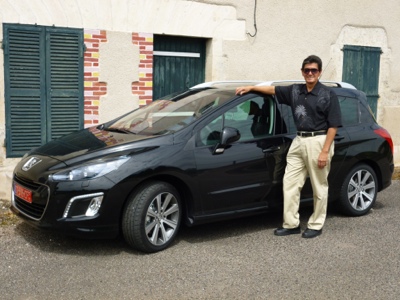
First of all, let me preface the following with the fact that I (Norman) have previously driven through France, Italy, and Spain (although it was more than twenty years ago). The one thing that is very important to learn if you do decide to drive in France, is what the various road signs mean. There aren’t many, but it is vital to recognize what appears along the roadway. Another is that in many European countries, the “roundabout” is a very common feature encountered at major intersections in large cities, small villages, and even out in the countryside. You merge in and out of a roundabout so it is important to signal your intentions when you enter and are about to leave the roundabout. Signaling your intentions assures that everyone knows what you intend to do.

I have driven in very heavy and congested traffic in Paris, Lyon, Annecy and many small towns and villages. Keep in mind that many of the old city’s and especially the villages’ roadways were built for ox carts, not cars! The streets are narrow or windy or both and turning into side streets can be very sharp and short. Many smaller villages have few if any sidewalks so look out for pedestrians and bicyclists. You will also be sharing very narrow roads with 18-wheelers coming your way! So slow down and squeeze on by. They will be doing the same. I have to say that even in the heaviest congestion, almost all drivers have been calm, considerate, and courteous. When driving on two-lane roads, stay to the right (even if there is no one behind you). I learned rather quickly that cars that seemed to be far behind you caught up to you much more quickly than you thought they would. Also, in France, you can only pass a car on the left even if you are on the right-hand lane of a two-lane highway going in the same direction with no car in your lane in front of you. Many times I have seen cars going down the right-hand lane and as they catch up to a car in the left lane, they will slow down and switch to the left lane behind the slower car expecting it to move to the right-hand lane. So don’t dilly-dally; move and stay in the right-hand lane even after passing. Look out for speed traps. You will recognize them when you see a sign telling you that “for your protection, your speed will be monitored” (in French of course).

Gas prices in France are some of the highest in the world. It is not that the price of oil is higher for the French (as compared the the U.S. for example), but that the government adds a hefty tax to every liter of gas (as much as 70%) — enough of a tax to make the price equivalent to about $6.50-8.00 per gallon. Why such high taxes? Taxes collected from the sale of gas for motor fuel pay for the very extensive and excellent roadways. Every paved road we have been on was in excellent shape. When driving through tunnels and over long spans of bridges, they too were very well-maintained. Even when driving down what seemed one-lane country roads far from anywhere, we have noticed how good the quality of the roadways have been. As with everything, there is a price to pay for quality. I don’t think the French complain too loudly about the price of gas, given the excellent quality of their roadways. The French are a practical people and will walk, bicycle, or take public transportation before they needlessly spend money on gas.

Keep in mind other expenses you will encounter if you plan to drive between two distant locations…toll roads. There are many throughout the country. You probably can get from one location to another by taking non toll roads, but be prepared to take a lot longer getting there. Sometimes you might double the length of your drive time if you decide not to take the toll road. Tolls roads can be expensive, but there is no more direct route from one place to another. On the other hand, when we took non toll roads on side trips, we got to see some very beautiful landscapes, country roads, and many charming villages. Another expense is parking. By planning ahead, you can use inexpensive or even free public parking lots.

The last piece of advice I can offer is to use the Internet as much as possible when planning your travel. We have been able to get very detailed information on almost all our destinations that pertains to driving via the Internet. Parking information, rates, driving directions, locations, number of parking spaces, security, etc. can be had ahead of time on your mobile phone or iPad.

All in all, I’d have to say that having a car is the best way to see the country. You can get to places that are either inaccessible by public transportation or would be arduous to get to at best. However, driving can be stressful, so plan ahead, get informed, and stay frosty.

Here are some equivalents:
1 liter= .26 U.S. gallon (1 US gallon = 3.78 liters)
Our car’s capacity of diesel is 60 liters (16 gallons)
The Euro = $1.25 U.S. Dollars
To fill up the 16 gallon tank @ 1.40 Euros per liter costs approx. 84 Euros ($104).

Distances and speed are measured in kilometers.
1 km = .621 miles (1 mile = 1.6 km)
Highway speeds as high as 130 km per hour are allowed = 80 miles per hour

On the Road in Provence

20120626-182325.jpg

Roussillon

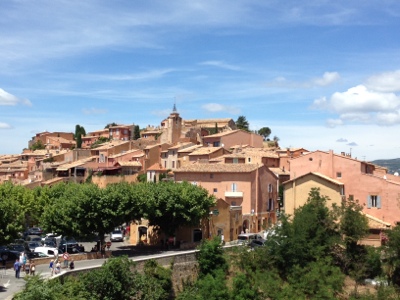
Roussillon is a small village set atop appropriately named Mont Rouge (Red Mountain) in the Luberon district of Provence. There really aren’t any particular sights to see — no castles, museums, or medieval ramparts — which can actually be a welcome relief for the long-term visitors like us. Roussillon’s attraction is purely one of beauty and charm stemming from its one unique feature. It sits on the world’s largest deposit of ochre, a reddish clay which produces a pigment that has had many uses throughout history. Primarily it is has been used in paints. The mining of ochre was the town’s economic base until WW II when cheaper substitutes were found.

A winding narrow road leads up the hill to Roussillon’s 2,000-foot high perch. At the top, the spectacular views are accompanied by a stiff wind better known as the legendary mistral. A walk around the quaint village, now totally dependent on tourists for its income, provides a sufficient amount of Provençal charm. Surrounded by red cliffs, the houses are painted in shades of yellow, brown, and red ochre accented with brightly colored shutters and doors which provide inspiration for any artist’s or photographer’s palette. This is how we enjoyed our time in Roussillon — capturing intriguing images created by the combination of shapes and colors.

20120626-182522.jpg

Avignon

Avignon’s claim to fame is that it was the headquarters of the Catholic church for 94 years beginning in 1309 when the first (and last) French Pope was elected. The church bought up the then tiny village and turned it into a Catholic metropolis which it believed would be much more secure than continuing residence in Italy. The town still thrives today but is no longer under the church’s influence and once again belongs to the French. What remains are various palaces, bridges, and fortresses that were built to support and defend the church’s endeavors.

A mix of old and new, Avignon is a combination of narrow cobblestone streets and wide avenues. It sports architectural styles from many periods in history. The Palace of the Popes covers 3 acres and is the largest surviving Gothic palace in Europe. The Church of St. Pierre holds an ornate golden Baroque alter. A few examples of architecture exist from the Middle Ages and can been seen in some buildings along the narrow streets now inhabited by residents and shopkeepers. And, if you’re not yet confused about where you are in the historical timeline, there’s a synagogue from the 11th century that was redone in Neoclassical Greek style in the 19th century.

This architecture and its accompanying ambience are what attracted us to visit Avignon. As we approached the walls of the city by crossing the Daladier Bridge on foot, we took in the views across the Rhone River. Once inside, we strolled past all the notable sights stopping here and there to sit, look, and listen. Eventually, we made our way to the park at the top of the hill, Jardin du Rochers des Doms, where more beautiful vistas of the Rhone River Valley awaited. Shaded from the increasingly warm sunshine and cooled by a strong wind while resting in this lush park, we were able to truly appreciate this opportunity to spend time in one of France’s most heralded regions, Provence.

If you haven’t discovered them already, please take a look at the individual gallery pages titled by region with additional photos from our travels. More to come…

Only Lyon

20120623-223548.jpg

Our transition from the Alps to Provence led us to a one-night stay in Lyon, the second largest city in France. Lyon is unique for many reasons. It is an strange mix of old and new since the Nazi’s did their best to destroy everything on their way out in 1944. It has one of the most efficient and environmentally friendly transportation systems anywhere with electric buses, a tramway, Metro, pedal taxis for short trips, and over 1,000 city-owned bikes available for use at various locations.

Lyon, not Paris, is truly the City of Light. On December 8, 1852, a golden statue of Mary was placed atop the Basilica of Notre Dame. Everyone in the city welcomed her by lighting candles in their windows. This became a tradition and spawned an industry that has made Lyon the leader in state-of-the-art flood lighting displayed every evening with brilliantly floodlit buildings, and sights throughout the city.

20120623-223651.jpg

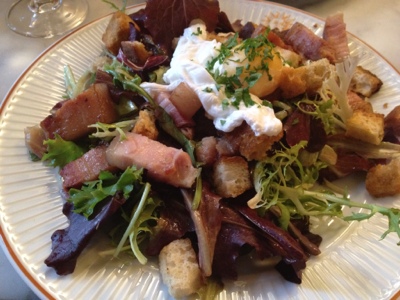
More than anything else, however, Lyon is renown for its gastronomy perhaps spurred on by chef Paul Bocuse who is considered to be the ambassador of modern French cuisine. There are two traditional dishes for which Lyon is famous — Salade Lyonnaise and Quenelles. They are typically served at bouchons — small bistros that used to serve the silk workers during Lyon’s silk producing heydays in the 1800’s. I set out to research the best (and most reasonable) place to try them out. It took a bit of time, but I eventually found Café du Soleil whose owner is reputed for producing some of the best quenelles in France and providing them to over 100 local restaurants including those of Paul Bocuse. The restaurant is located in the area of Old Lyon where ancient buildings line narrow cobblestoned streets. Small, warm, and welcoming, it is decorated in dark woods and sun-themed (soleil) paraphernalia. We ordered a menu that included a salad, main dish, and dessert for one price plus a pitchet (more or less the equivalent of a half carafe) of Beaujolais. We both chose the Salade Lyonnaise as the starter which consists of a variety of greens in a light vinaigrette accompanied by salty chunks of ham and crispy croutons and topped with a poached egg — delicious and really a meal in itself. For the main dish, we each chose a different type of quenelle — one fish and one chicken. These are large, oval-shaped dumplings made from flour, butter, eggs, and veal fat plus dried fish or chicken. They are poached and then served with a sauce similar to béchamel. At first taste, it is difficult to discern the exact flavors, but then it grows on you and becomes very “moreish”. They are extremely tasty but very filling — the best of comfort food on a cold day in Lyon as I can imagine there are many. For dessert, Norman enjoyed Île Flottante (floating island), one that is rapidly becoming his favorite — merengue floating on a vanilla custard with caramel sauce. My choice was two scoops of glacé (ice cream) — one lemon and one cassis. In the end, we were a bit stuffed but completely satisfied with an experience we could ONLY have in LYON.

Variations in Green

20120622-092648.jpg

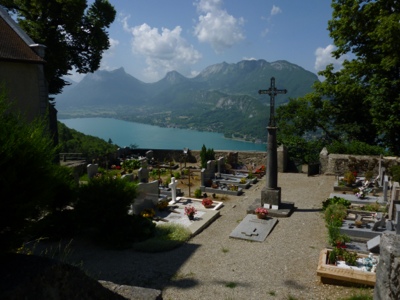
Saint Germain dedicated his life to the pursuit of purity. Isolating himself from the world, he spent his days as a hermit high above the hills of Talliores. The Hermitage of Saint Germain (and its small cemetery) overlooks the beautiful lake of Annecy (La Lac d’Annecy) and is dedicated to this hermit saint. Today we walked the trail of Saint Germain. Starting from our bed and breakfast, we walked up the mountain to the Hermitage, where we enjoyed a spectacular view of the lake and surrounding “mastiffs” (dramatic mountains that give this area such appeal). After a short rest, we continued up again to a high valley, then down into the lush green forest following the saint’s very own path — a walk that took us on a five kilometer (3.10 mile) mountainous loop.

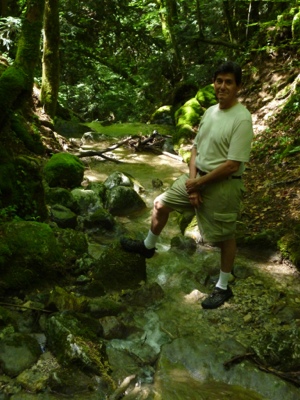
Here, green is the color of spring. Light green, like the soft green skin of the an unripe fig, clings to the bark of a tree. Glance away and you the catch the dark blue pear green contrasted by deep brown purple green of the moss firmly anchored to weathered stone. Take another step on the carpet of a thousand shades of green. The dappled sunlight highlights the vivid yellow greens of the canopy high above our heads as we walk by lichen covered rocks painted in shades of cream/red/melon/tan/brown/orange/avocado/grey greens. Green/white/blue leaves that lay on the ground are shaded by the vigorous growth of broad pastel lime green plants pushing their way past the grayish maroon greens of decaying branches and bramble. Look and you can see the dark grassy green along side the emerald greens in the sinuous veins of large boulders. On occasion, the powder bluish teal green of Lake Annecy could be seen through the phthalo green leaves of trees whose somber deep tones obscure individual shapes yet, they are framed by mint, asparagus and sea greens leaves backlit by the bright sunlight trying to push its way through the deeper/darker cucumber/watermelon/olive greens of the heavy, thick, lush green forest. As we walk along, we come to a fast running spring whose clear yet faintly greenish waters tumble down into a deep abyss of yet more variations of olive/turquoise/jade/amber/viridian and deep ocean greens.

20120622-092835.jpg

At last, after a couple of hours, we complete our journey, stopping where we started. Accompanied, surrounded, then enveloped in and finally released from Saint Germain’s trail’s springtime embrace.

The extended heavy spring rains this year have not only given this area this immense blanket of green, but everywhere you look, flowers of all shapes, sizes, and colors bloom. The local people appreciate this and supplement nature’s gift by providing concentrated clusters of multitudes of colors from window sills and patio rail containers that spill their cacophony of colors into your eyes.

This blog is dedicated to my daughter who is infatuated by Herman Melville’s ten-page description of white when referring to Captain Ahab’s nemesis, the great white whale…Moby Dick.

Post Navigation